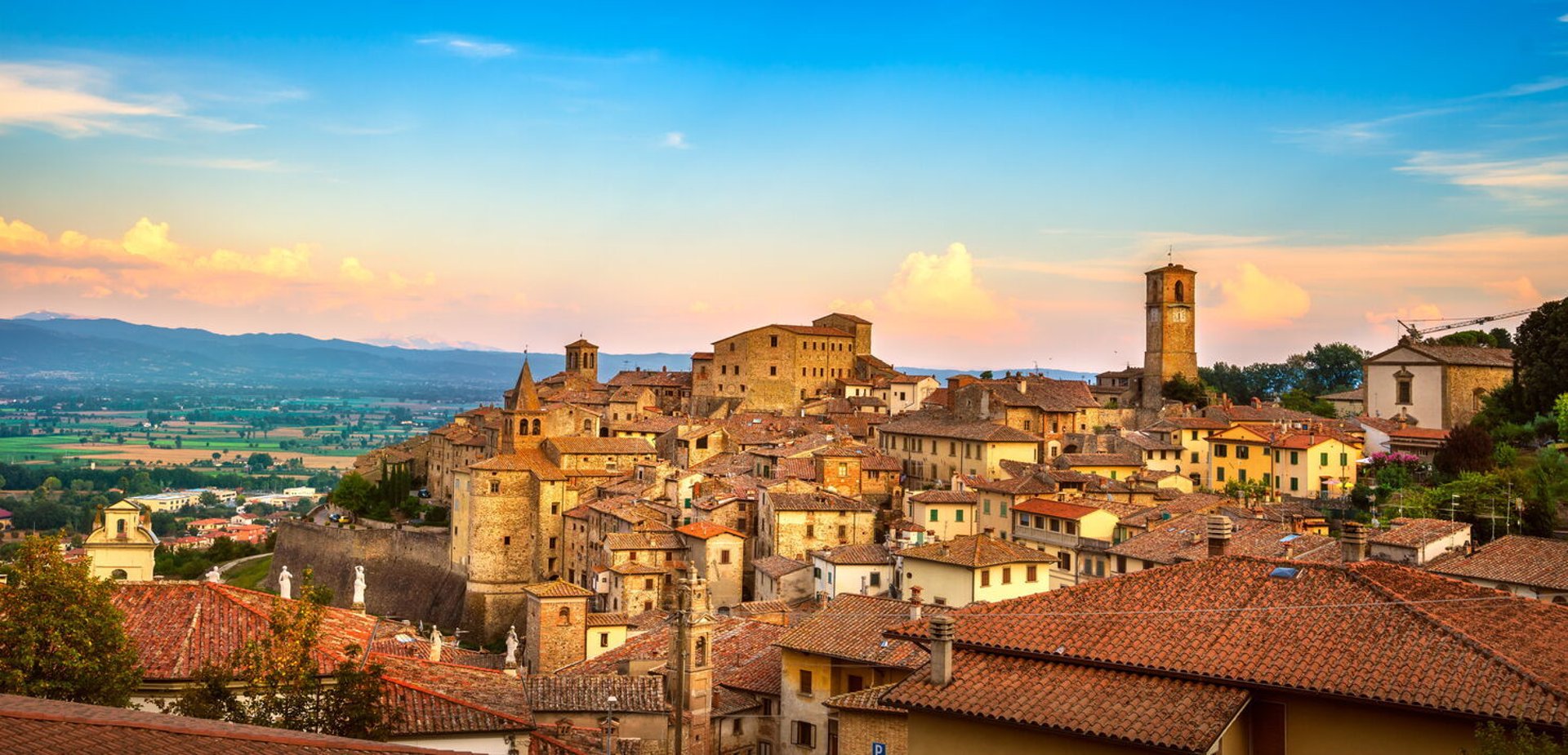
Arezzo
A journey through Renaissance masterpieces, medieval traditions, and millennial mysteries in the heart of Tuscany
Arezzo is a city that captivates at every corner.
Here Piero della Francesca painted one of the most important fresco cycles of the Renaissance, Roberto Benigni filmed the most iconic scenes of "Life is Beautiful," and every summer the main square transforms into the arena for one of Italy's oldest medieval jousts.
But Arezzo is not just art and folklore: it guards millennial secrets, from a 16th-century astronomical clock still functioning to a mysterious Romanesque church where the Templars left indelible traces.
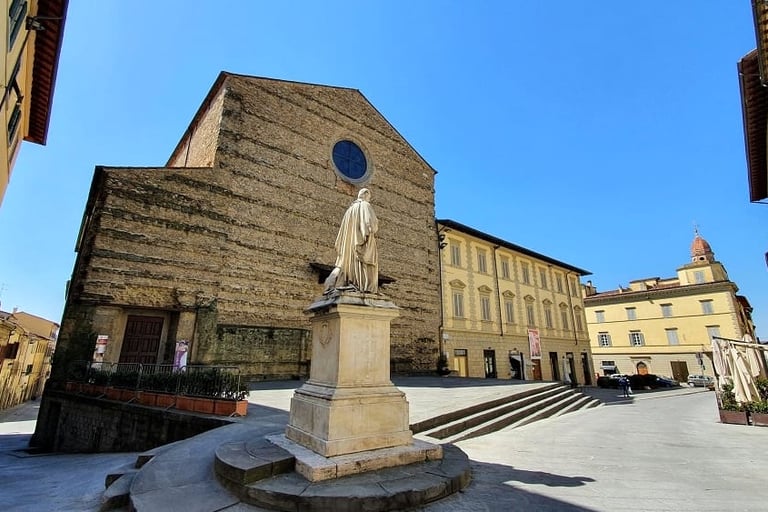
Basilica of San Francesco: The Legend of the True Cross
Piero della Francesca's absolute masterpiece
The Basilica of San Francesco holds one of the most precious treasures of Italian art: the fresco cycle of the Legend of the True Cross, painted by Piero della Francesca between 1452 and 1466. This extraordinary pictorial narrative tells the story of the wood of Christ's Cross, from its origin in the Garden of Eden to its discovery by Saint Helena.
Piero's perspective vision, the crystalline light illuminating the scenes, the colors seemingly suspended in time: everything here is perfect, calculated, mathematically sublime. The scenes don't follow chronological order but are arranged according to formal and symbolic relationships, creating a visual dialogue that leaves you breathless.
📍 Podere's tip
Book your visit in advance (maximum 30 people per 30-minute slot). Try to arrive in the early morning hours, when natural light enhances the colors of the frescoes even more. In one of the Discovery of the Cross scenes, in the background, Piero painted Arezzo itself perched on its hill: a detail that makes this masterpiece even more special.
Piazza Grande: Arezzo's Beating Heart
Between medieval jousts, astronomical clocks, and cinema
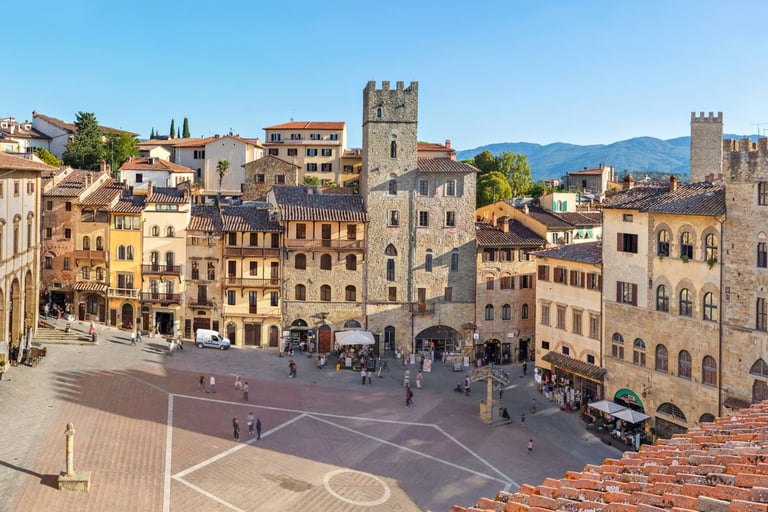
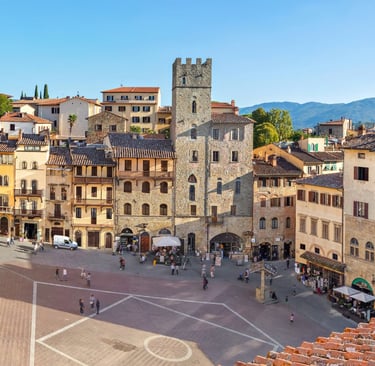
Piazza Grande is much more than a square: it's the stage of Aretine life. Its characteristic sloping trapezoidal shape, surrounded by buildings from different eras, creates a unique atmosphere that even conquered Hollywood. Right here Roberto Benigni filmed some of the most iconic scenes of "Life is Beautiful," like the one with the family on a bicycle crossing the square ringing the bell.
The astronomical clock that defies time
On the Palazzo della Fraternita dei Laici stands one of Arezzo's most fascinating treasures: an astronomical clock from 1552, built by master clockmaker Felice di Salvatore da Fossato. It's quite probably the last manually wound clock in the world. It doesn't just tell time: it shows the position of the Sun and Moon according to the 16th-century Ptolemaic conception, with three bells (one from 1300) that ring at different rhythms.
The dark secret: Legend has it that Felice da Fossato, after completing this extraordinary work, was blinded or even murdered by his patrons to prevent him from creating others. The historical truth is less dramatic: the clockmaker peacefully returned to Fossato di Vico after receiving his agreed payment. But the legend survives, fueled by the almost magical complexity of this mechanism that, after almost 500 years, continues to function perfectly.
La Giostra del Saracino
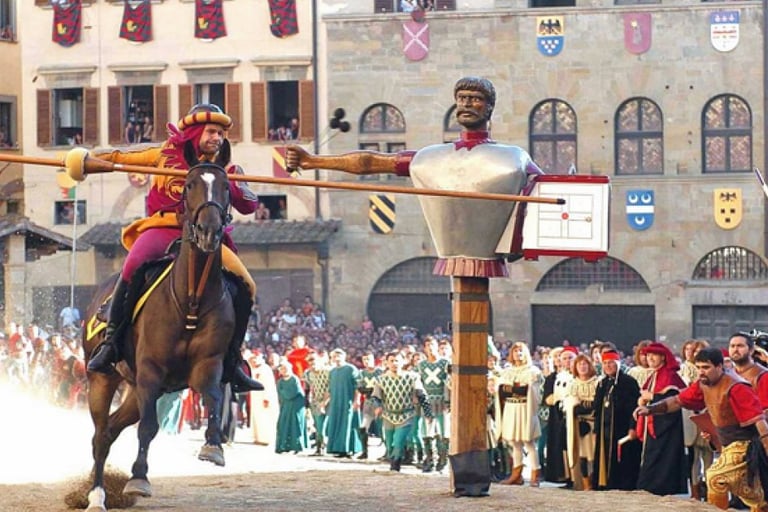
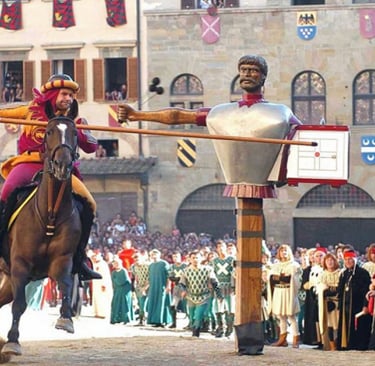
Twice a year, Piazza Grande transforms into the arena for the Giostra del Saracino, a medieval equestrian tournament that sees the city's four quarters compete. The penultimate Saturday in June (at night) and the first Sunday in September (daytime), over 300 costumed figures parade through the city streets before the challenge: the jousters must hit the shield of the Buratto, a rotating metal dummy, with their lances while avoiding its flail. Dante himself mentions it in the Inferno: "I saw riders through your land, O Aretines, and saw raiding parties, jousts being run".
📍Podere's tip
Stroll under the Vasari Loggia, designed by the great Aretine artist in 1550. Here Guido and Dora, the protagonists of "Life is Beautiful," experience their night of "miraculous events." If you visit Arezzo on the first weekend of the month, you'll find the Antique Fair, Italy's largest and oldest (since 1968), with almost 400 exhibitors.
📍 Events not to miss
- Giostra del Saracino: penultimate Saturday in June (nighttime) and first Sunday in September (daytime)
- Antique Fair: first Saturday and Sunday of the month
- Christmas Markets "Arezzo City of Christmas": November 15 - January 6 (Italy's largest Tyrolean Village)
Cathedral of Saints Peter and Donato: Light and Spirituality
Where Piero della Francesca painted the Magdalene
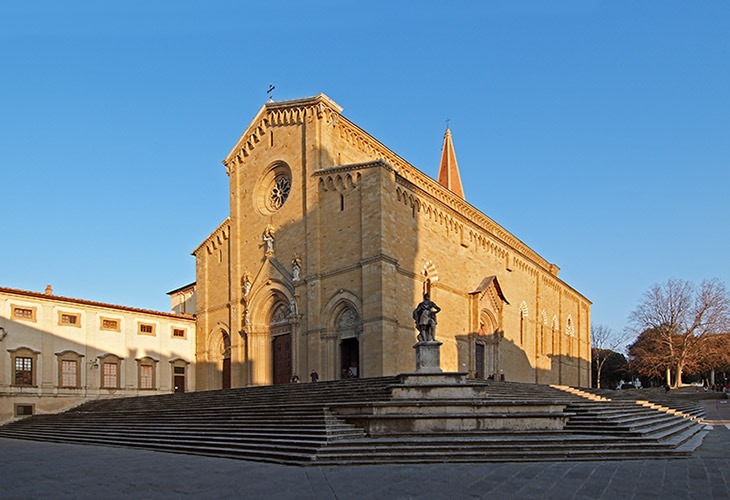
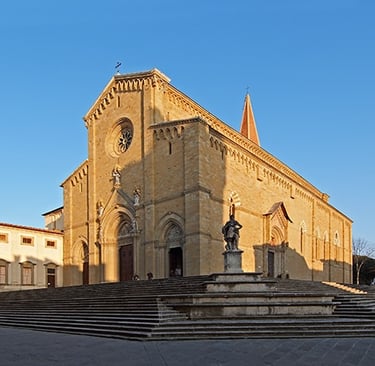
Climbing toward the upper part of the city, the Cathedral rises majestically on its staircase, dominating Arezzo from the hilltop. Construction began in 1278 by order of Bishop Guglielmino degli Ubertini (who died in the Battle of Campaldino in 1289), but was completed only in 1511, with the neo-Gothic facade added between 1900 and 1914.
Inside, the central nave is illuminated by five magnificent polychrome stained glass windows by Guillaume de Marcillat (1516-1524), an explosion of color that transforms light into art. But the most precious treasure is found in the left nave: the fresco of Piero della Francesca's Magdalene (1459), painted while the artist was working on the Legend of the True Cross. A monumental figure (190x105 cm), austere and powerful, unique in the painter's work.
The Chapel of the Madonna del Conforto, dedicated to the miracle of February 15, 1796 (when the sacred image reportedly stopped earthquake tremors), is a triumph of neoclassical art and houses splendid terracotta works by Andrea della Robbia. On the high altar stands the Ark of San Donato, a 14th-century marble masterpiece containing the remains of Arezzo's patron saint.
📍 Podere's tip
After your visit, take a break in the Prato, the large public park between the Cathedral and the Medici Fortress. From here the view over Arezzo and the valley is breathtaking, especially at sunset.
Casa Vasari: The Master's Residence
Inside the mind of a Renaissance genius
Giorgio Vasari was not only a great painter and architect (the Loggia in Piazza Grande is his), but also the first modern art historian with his famous "Lives." His house, purchased in 1541, is a perfect example of a Mannerist residence where each room tells a story.
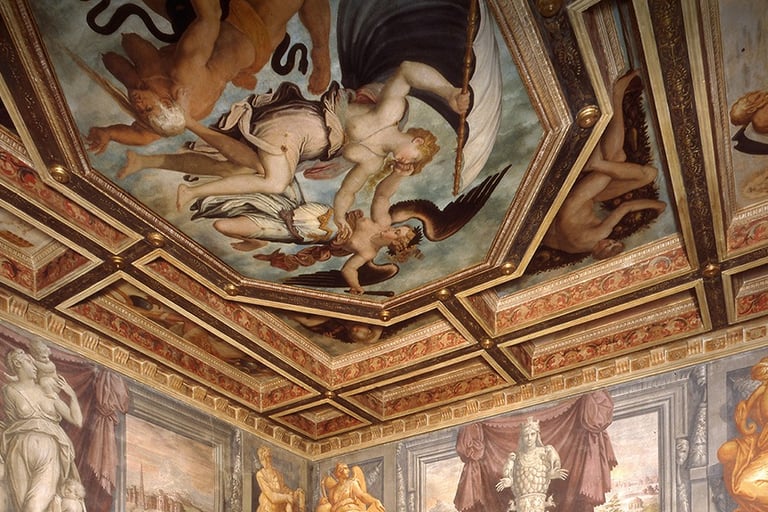
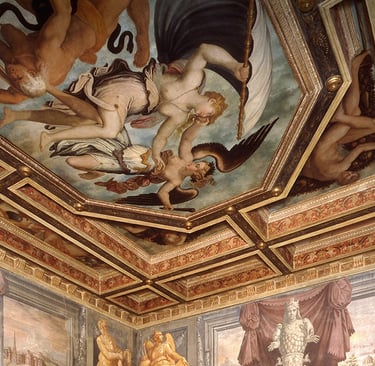
Vasari personally frescoed the rooms of the main floor with a precise iconographic program: to celebrate art and the artist's role. In the Hall of the Triumph of Virtue we find allegorical figures and great artists of antiquity; in the Chamber of Abraham (the nuptial chamber), God the Father blesses the generation; in the Chamber of Fame, Vasari painted his self-portrait along with portraits of Aretine artists or those from the territory: Lazzaro Vasari, Luca Signorelli, Spinello Aretino, Bartolomeo della Gatta, Michelangelo, and Andrea del Sarto.
The picture gallery houses works by Vasari and his collaborators, the so-called "studiolo painters" who decorated the Studiolo of Francesco I de' Medici in Palazzo Vecchio.
📍 Il Consiglio del Podere
If you have the combined ticket (recommended), continue to the Gaio Cilnio Mecenate National Archaeological Museum, built on the remains of the Roman Amphitheater. It preserves the world's richest collection of "coral vases," the Aretine pottery that made the city famous throughout the Roman Empire.
Pieve di San Pietro in Gropina: The Mystery of the Green Man
A journey through time among Templars and pagan deities
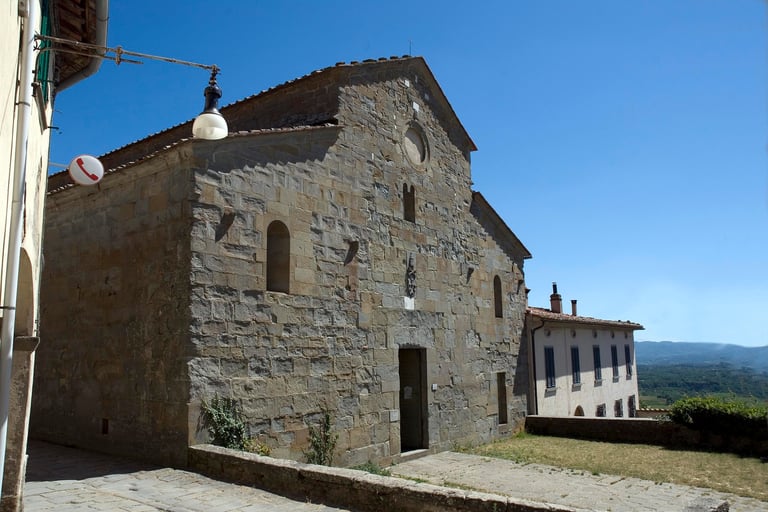
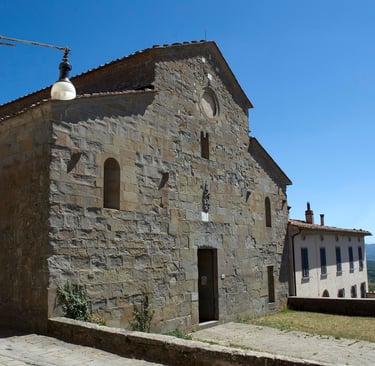
A few kilometers from Arezzo, in the village of Gropina (one of Italy's Most Beautiful Villages), hides one of Tuscany's most mysterious and fascinating places: the Pieve di San Pietro, the oldest Romanesque church in the Valdarno.
The mysterious capitals
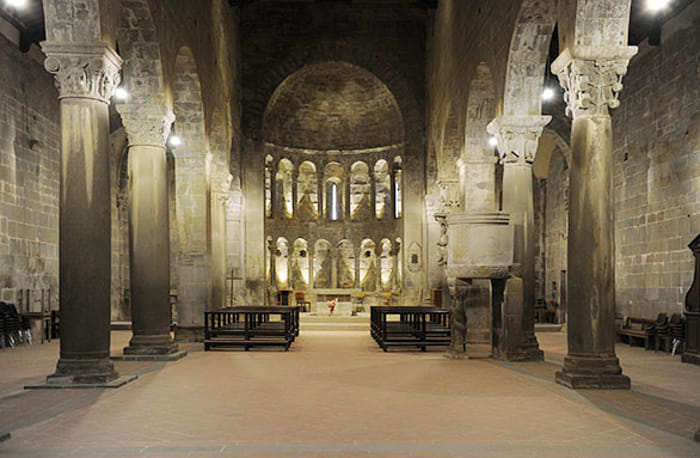
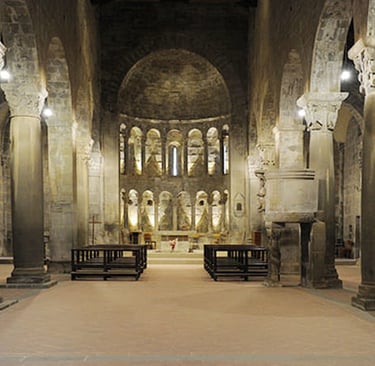
What makes this church unique are the capitals and pillars decorated with subjects that go well beyond traditional Christian iconography. Here Old and New Testament episodes coexist with pre-Christian, Etruscan, and Oriental symbols. On the first pillar on the left we find the chimera with its mouth wide open, the Etruscan symbol par excellence. Further on, clear examples of Templar knight representations: evidence of the Order's passage or stay in this place.
The Green Man: a universal enigma
But the real mystery is found on the capital of the second column on the left. Here, among lush and almost oppressive vegetation, emerge animal heads and human figures: a ram, a demon, a lion, a human figure. It's the representation of the Green Man, a recurring symbol in cultures worldwide, from Asia to the Americas.
According to some interpreters, the Green Man would symbolize the forces of evil that, through nature, try to bend man's will. For others, it's a figure linked to nature deities: the Celtic Cernunnos, the Greco-Roman Pan and Dionysus, the Egyptian Osiris, the Norse Odin. Today neo-pagans link it to the Horned God, worshipped together with the Triple Goddess.
Three superimposed churches
The current church, founded around the year 1000, rises on the remains of two previous churches visible on the lower floor: the first from the 5th-6th century and the second from the 8th-9th century. A place of uninterrupted worship for over 1500 years, where Christianity and paganism intertwine in a silent but powerful dialogue.
📍 Podere's tip
This stop deserves at least an hour. Bring a flashlight or use your phone's to observe the capital details well. The natural light filtering through the small windows creates shadow plays that make the carved figures even more evocative. If you're passionate about mysteries and history, this is one of those places you'll never forget.
PRACTICAL INFORMATION
📍 Distance from Podere
How to get there from Chiusi
- Car: 80 km, about 1 hour via SS146 and E45
- Train: Chiusi-Florence, then Florence-Arezzo (change at Florence SMN)
Where to park
- Pietri Parking (recommended): Free (some areas) with escalators to the historic center
- Mecenate Parking: €0.70/h, daily rate €3
- Baldaccio Parking: €0.70/h, daily rate €3
- Cadorna Parking: €1.50/h (8:30-20:30)
- Beware of ZTL zones: Zone A (weekdays 8:30-12:00 and 17:00-20:00), Zone B (daily 8:00-24:00)
⏱️ Where to eat
- Trattoria Il Saraceno (Via Mazzini 6): typical Tuscan cuisine, famous for pici all'aglione and "nana" (roasted duck). Informal atmosphere, excellent value
- Under the Vasari Loggia: numerous restaurants with outdoor tables overlooking Piazza Grande
🌅 Podere's extra tip
If you visit Arezzo during the Christmas period (November 15 - January 6), don't miss "Arezzo City of Christmas" with Italy's largest Tyrolean Village in Piazza Grande, markets, light shows, and Santa's House in the Medici Fortress.
If you come on the first weekend of the month, spend a couple of hours at the Antique Fair: it's a unique experience just for the atmosphere. And remember: Arezzo is easily walkable, but it's an uphill city. Comfortable shoes required!
Ready for Arezzo?
Discover Arezzo in one day: from Piero della Francesca's Legend of the True Cross to the Giostra del Saracino, the astronomical clock, and the mysteries of Pieve di Gropina. Complete guide with parking and restaurants.