Highlands Tour
Monte Amiata: In the Highland Between Villages, Beech Woods and Endless Skies
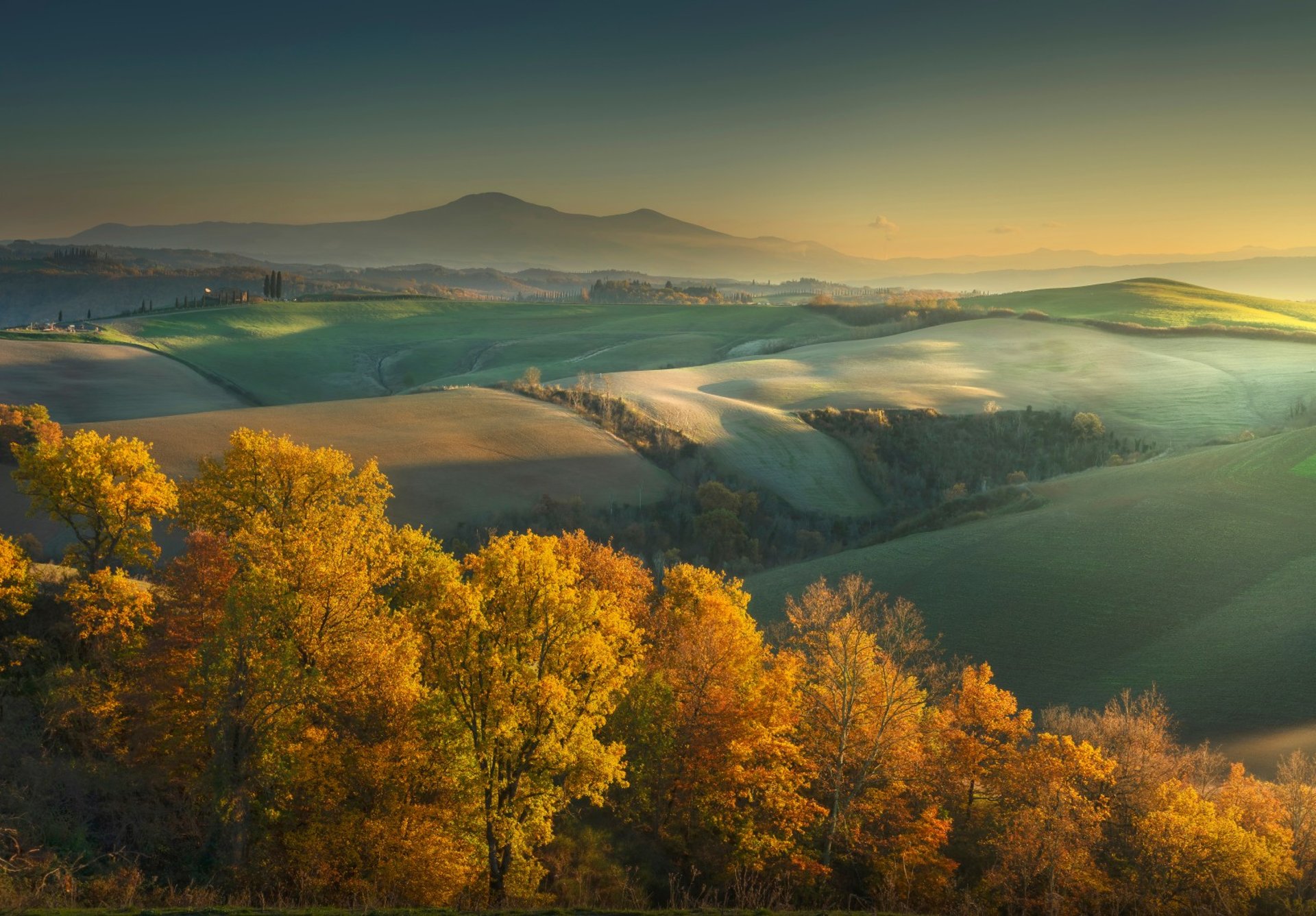
When Val d'Orcia climbs toward the sky and the warm colors of the hills give way to the deep green of woods, you've reached the realm of Monte Amiata. This extinct volcano rising 1,738 meters above southern Tuscany isn't just a mountain: it's a world of medieval villages perched on volcanic rock, centuries-old beech forests where silence sounds like wind through leaves, crystal springs that quench entire cities. Here the air smells of chestnuts and mushrooms, thousand-year-old abbeys guard stories of Longobard kings, and in every village you breathe the pride of those who learned to live from the mountain without ever bending it.
Three authentic villages, trails through Europe's largest beech forest, and a small family business transforming wild rose hips into memorable breakfast jams.
The call of the mother mountain
The itinerary follows Monte Amiata's slopes and summit between Siena and Grosseto provinces, touching three historic villages while leaving space to immerse in mountain woods. From Abbadia San Salvatore, the largest town and gateway to the summit, you descend toward Santa Fiora, the water village with its famous Peschiera. From there, climbing northeast, you reach Vivo d'Orcia, a small hamlet where crystal springs are born in the forest's heart. Between villages, the mountain offers trails through centuries-old chestnut groves and spectacular beech forests, with views that on clear days span from Gran Sasso to the Apennines, from Maremma to the Tuscan Archipelago.
STOP 1: ABBADIA SAN SALVATORE
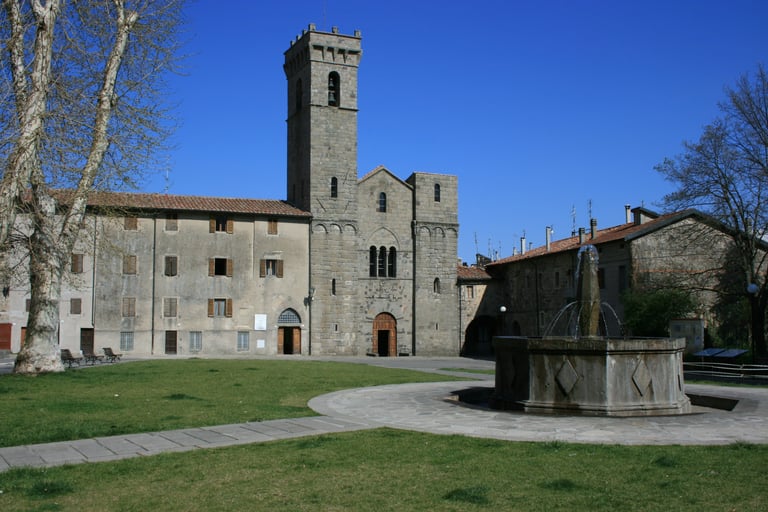
Abbadia San Salvatore is Monte Amiata's largest village, perched at 800 meters altitude. Its name comes from the Abbey of the Holy Savior, founded according to legend in 743 AD by Longobard king Ratchis after a vision of the Trinity above a white fir tree. The abbey dominates the historic center with its imposing facade flanked by two towers. Inside, the 7th-century Romanesque crypt is a jewel: 32 columns with capitals all different, decorated with animals, plants and geometric motifs. Here for centuries was kept the Codex Amiatinus, the oldest complete manuscript copy of the Latin Bible, now in Florence.
The medieval village winds through narrow, picturesque streets that preserve ancient atmosphere. Don't miss the Mining Museum Park, telling the story of mercury mines that from 1800 until the 1970s made Abbadia one of the world's most important industrial centers. You can travel a section of gallery on a miners' wagon and see period tools. If you visit Abbadia in winter, on Christmas Eve experience the spectacular Torches: enormous pyramid-shaped wood stacks are lit simultaneously at 6 PM on December 24th, illuminating the entire town in a unique celebration attracting thousands of visitors.
📍 Podere's tip
Before climbing toward the summit, stop at one of the town's bakeries to taste Ricciolina, Abbadia's typical cake. It's a shortcrust pastry filled with chocolate cream, hazelnuts and meringue: pure energy for mountain trails. And if wine accompanied you here, breathe the mountain air on Amiata and prepare for views that will make you forget the hills.
STOP 2: SANTA FIORA
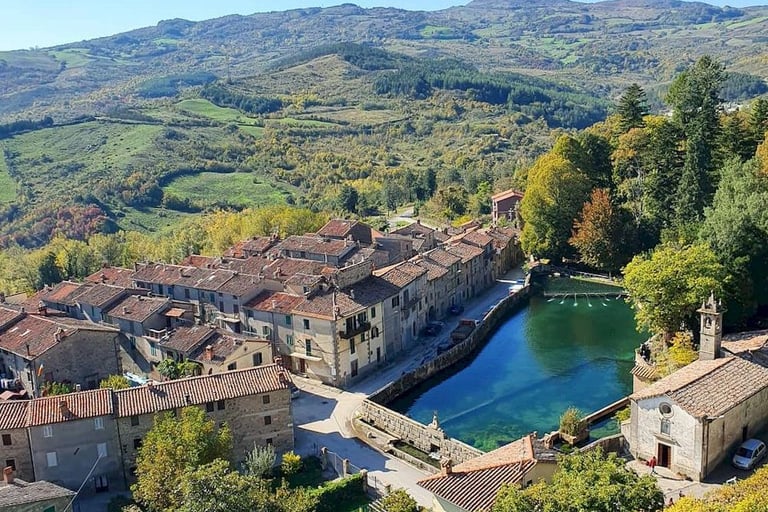
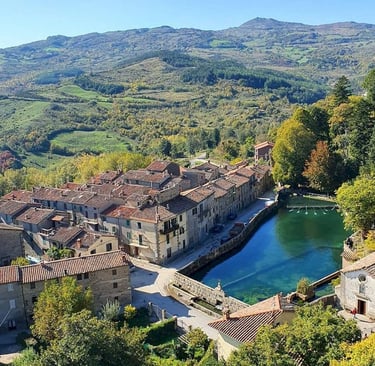
Descending from the Siena side to Grosseto's, you meet Santa Fiora, one of Italy's Most Beautiful Villages with Touring Club Orange Flag. Perched on a volcanic rock spur, Santa Fiora is the "water village": here the Fiora river is born, springing right beneath the town. The Peschiera is the village's heart: a large 15th-century basin surrounded by an English-style park, with centuries-old trees reflecting in crystal water. Created by the Aldobrandeschi for trout farming, then transformed into a noble garden by the Sforza Cesarini. Walking its paths is an experience of absolute peace.
Next to the Peschiera, the small Church of Madonna della Neve hides a marvel: the glass floor allowing you to see the Fiora spring flowing right beneath your feet. A rare emotion, watching water born from volcanic rock beginning its journey to Maremma. In the historic center, divided into three medieval districts, rises Palazzo Sforza Cesarini with its imposing Clock Tower. Inside, the Mercury Mining Museum tells Monte Amiata's mining history. The Church of Sante Flora and Lucilla houses one of the world's most important collections of della Robbia terracotta.
📍 Podere's tip
If you have time, book the guided tour of the Fiora River Springs Gallery (620 meters underground where water exits rock with impressive roar). And passing through Santa Fiora, look for La Rosa Amiantina products in village shops: they're the same we serve at breakfast, rose hip jams hand-picked on these mountains. If you want to meet the producers directly, we'll tell you in the special experience section.
STOP 3: VIVO D'ORCIA
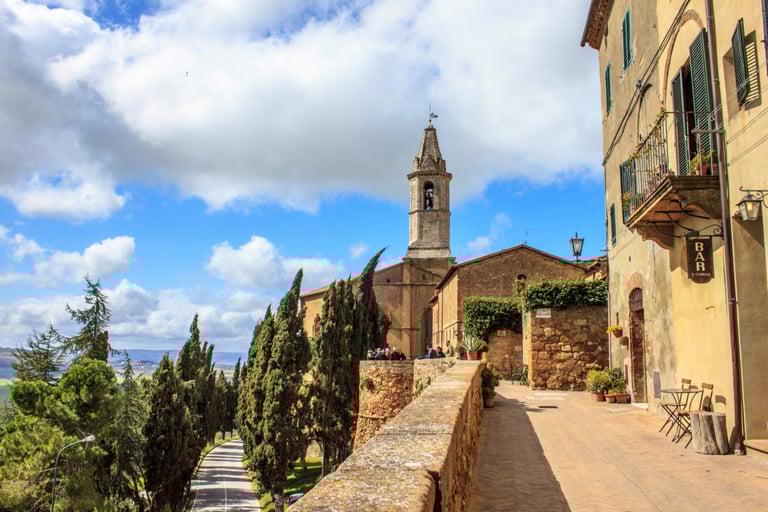
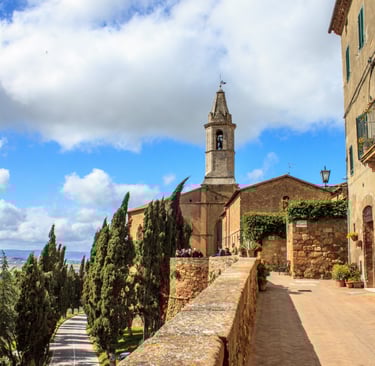
Climbing northeast, above 1,000 meters altitude, you reach Vivo d'Orcia, a small hamlet of Castiglione d'Orcia immersed in woods. The name says it all: here the Vivo stream is born from pure springs that since 1914 feed Siena's aqueduct. The Vivo Hermitage, in Contea locality, is what remains of the ancient Camaldolese monastery founded in 1004 by Saint Romuald. The monastery was transformed in the 16th century into the majestic Palazzo Cervini, probably designed by Antonio da Sangallo the Younger, when Pope Paul III ceded the lands to Cardinal Marcello Cervini (future Pope Marcellus II, in office only 22 days).
The true pearl though is the Ermicciolo, a small Romanesque church hidden in the chestnut woods, right next to Vivo's springs. The 7th-century building, with its checkered facade in volcanic rock of different shades and apse with hanging arches, is disarmingly beautiful in its simplicity. The path connecting Hermitage to Ermicciolo crosses a small valley with waterfalls, caves (partisan refuge during the war) and the charming Lovers' Bridge. Water gushes from rock with energy, creating a spectacle that reconciles with nature's rhythms.
🌲 Podere's tip
Vivo d'Orcia is a tiny but authentic village. If you arrive in spring or summer, you'll see water flowing everywhere, creating an almost Alpine atmosphere in Tuscany's heart. The air here is crisp even in July, and silence is broken only by water's sound. Perfect for those seeking real mountain, far from everything.
NATURE: Monte Amiata's Trails and Beech Forest
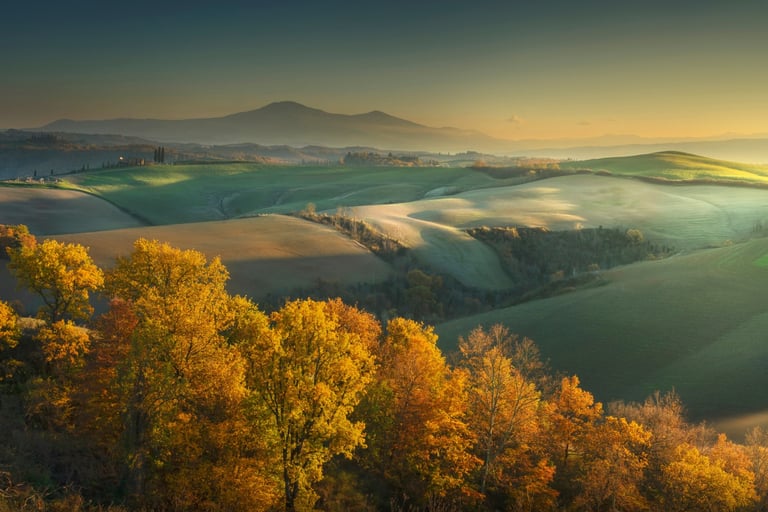
Monte Amiata isn't just villages: it's a mountain to walk. The beech forest descending from the summit (1,738 meters) to 1,000 meters is considered among Europe's most extensive. In spring and summer, dense canopies create shaded areas where ground is clean and easy to walk. In autumn, colors range from green to golden yellow to fiery red in a chromatic symphony. The oldest beeches are 4 centuries old and reach 40 meters height. Below 1,000 meters begin centuries-old chestnut groves, with trees producing the famous Monte Amiata Marrone IGP.
Trails are numerous and well-marked, for all levels. The Cross-Country Track Trail (5 km, 65m elevation) starts from First Amiatino Refuge and crosses the beech forest easily, perfect even for families. The Rigale Trail (5 km, 330m elevation) climbs through streams and woods to Pian della Pescina. For the most trained, Capomacchia Trail (22 km, 700m elevation) is demanding but rewards with spectacular Maremma views and allows reaching the summit. From the top, on clear days, gaze spans all central Italy: from Gran Sasso to Sibillini, from Bolsena lake to the sea. Beneath your feet, the mother mountain that for centuries nourished communities with its woods, waters, fruits.
📍 Podere's tip
If you're not an expert hiker, the Cross-Country Track Trail is perfect: easy, panoramic, immersed in beech forest. Bring a jacket even in summer (it gets cool at altitude), hiking shoes, and enjoy the forest silence. And if you love mountain biking, at Prato delle Macinaie find an equipped bike park for downhill.
✨ SPECIAL EXPERIENCES - La Rosa Amiantina: From Forest to Breakfast
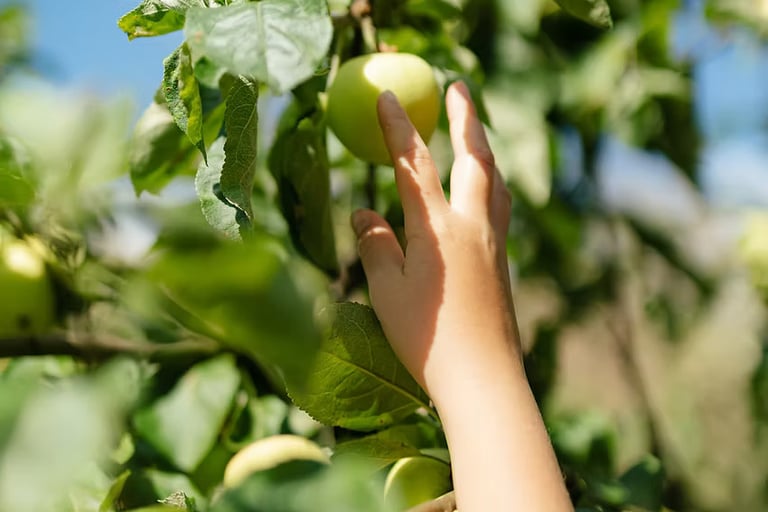
Those jams you spread at breakfast on Sonia's bread have a story. They're born on Monte Amiata, from the hands of a small family farm called La Rosa Amiantina. They hand-pick rose hip berries from wild bushes growing everywhere on Amiata - in fields, along trails, at forest edges. Rose hip is that plant you see everywhere in mountains, with pale pink flowers in spring and red berries in autumn. Precious berries, concentrated with natural vitamin C, that in the past were essential food for mountain farming families. La Rosa Amiantina doesn't just pick them: they work them with artisan care, remove seeds and fuzz, dry the pulp at low temperature to maintain all properties, and transform it into extra jams, honey with pure rose hip powder, teas, and the famous 100% powder to add to smoothies and yogurt.
Every product is made with respect for nature and its times, without preservatives or added flavors. The result? The best jams we've ever tasted, guests always say. If passing through Santa Fiora or Abbadia you see their products in village shops, that's them. Forgotten products that a family chose to bring back to life, with a touch of innovation but always with feet firmly planted in Amiata's soil.
Note: La Rosa Amiantina is based in Abbadia San Salvatore. For information on visits or direct purchases, ask us: they're our dear friends and suppliers.
USEFUL INFO
📍 Distance from Podere
Abbadia San Salvatore: 26 km (30 minutes)
Santa Fiora: 35 km (40 minutes)
Vivo d'Orcia: 40 km (45 minutes)
Between stops:Abbadia San Salvatore - Santa Fiora: 9 km (12 minutes)
Santa Fiora - Vivo d'Orcia: 18 km (20 minutes)
Vivo d'Orcia - Abbadia San Salvatore: 15 km (18 minutes)
Practical information:Parking: Free in all villages, marked at entrances
Full day route: Complete itinerary requires a full day (approx. 9 AM-6 PM). If you want to hike, dedicate at least half day just to trails
Trails: Well-marked, downloadable maps with "Abbadia S.S. 3.0" app or on Amiata Runners website
Abbadia Abbey: Open daily, crypt visitable (free entrance, donation)
Abbadia Mining Museum: Saturday and Sunday 10 AM-12 PM / 4 PM-7 PM, July-August also other days
Santa Fiora Peschiera: Access with small donation
Vivo d'Orcia Ermicciolo: Always accessible (it's outdoors)
Trail difficulty: From easy (Cross-Country Track) to challenging (Capomacchia, Summit)
⏱️ Tips for best experiences
- Clothing: Even in summer bring fleece or windbreaker for summit and altitude trails. Hiking shoes if you want to walk in beech forest
- Timing: Start from Abbadia in morning (visit abbey and village), continue to Santa Fiora for lunch, dedicate afternoon to Vivo d'Orcia and maybe a short trail. If you prefer hiking, skip a village and dedicate half day to trails
- Trails: Cross-Country Track Trail is simplest to taste beech forest without effort. If trained, Capomacchia Trail gives strong emotions
- Water: Bring bottle: you can refill at fountains in all villages (pure spring water)
- Local products: Chestnuts, porcini mushrooms (in season), Monte Amiata Marrone IGP, pecorino cheeses, Olivastra Seggianese DOP oil. And obviously Abbadia's Ricciolina
- Food: Typical dishes to seek: acquacotta (vegetable soup), pici all'aglione, wild boar with polenta, mushroom soup in bread crust. In summer, local cured meats and cheeses for altitude picnic
- For families: Amiata is perfect for children. Easy trails, villages to explore, fresh air. Mining Museum Park in Abbadia will fascinate them (gallery train!)
- Winter: If snow comes, ski lifts are at First Amiatino Refuge (alpine skiing) and along Cross-Country Track (Nordic skiing). Snowshoeing in snowy beech forest unforgettable.
🌅 When to go
Spring (March-May):
Forest awakening. Beeches put out first bright green leaves, meadows fill with wildflowers, springs gurgle at maximum flow. Cool temperatures perfect for walking (50-65°F). Rose hips bloom in May. Ideal for hiking and nature photography.
Summer (June-August):
The perfect season. While the plain swelters, Amiata offers pleasant temperatures (68-77°F at altitude, even less at dawn). The beech forest is a cool refuge even in central hours. Villages come alive with festivals and concerts. Ideal for breathing clean air, walking without sweating, and enjoying endless sunsets from the summit.
Autumn (September-November):
The color show. The beech forest becomes a kaleidoscope of yellows, oranges, reds. Chestnut groves offer first chestnuts. It's porcini mushroom time (silent seekers in woods at dawn). Temperatures still mild until October, then cooler. Chestnut and Mushroom festivals in Santa Fiora and Abbadia. Magical autumn light for photography.
Winter (December-February):
Amiata becomes white mountain. Possibility of snow even in villages, certain at summit where ski lifts operate (alpine and cross-country skiing). Christmas Torches in Abbadia (December 24th) are unique experience. Beech forest under snow is fairytale-like. Lit fireplaces, icy air, total silence. Cold temperatures (32-46°F), but authentic mountain charm. Ideal for true winter lovers.
Ready to breathe the highland air?
Contact us to organize your stay at Podere Grotta Antica and experience Monte Amiata as few know it.