Perugia
The closest city to Podere. Just 35 minutes away, discover a vibrant university capital hiding millennia-old secrets: from the Virgin Mary's wedding ring guarded with 14 keys to the Templars' underground paths
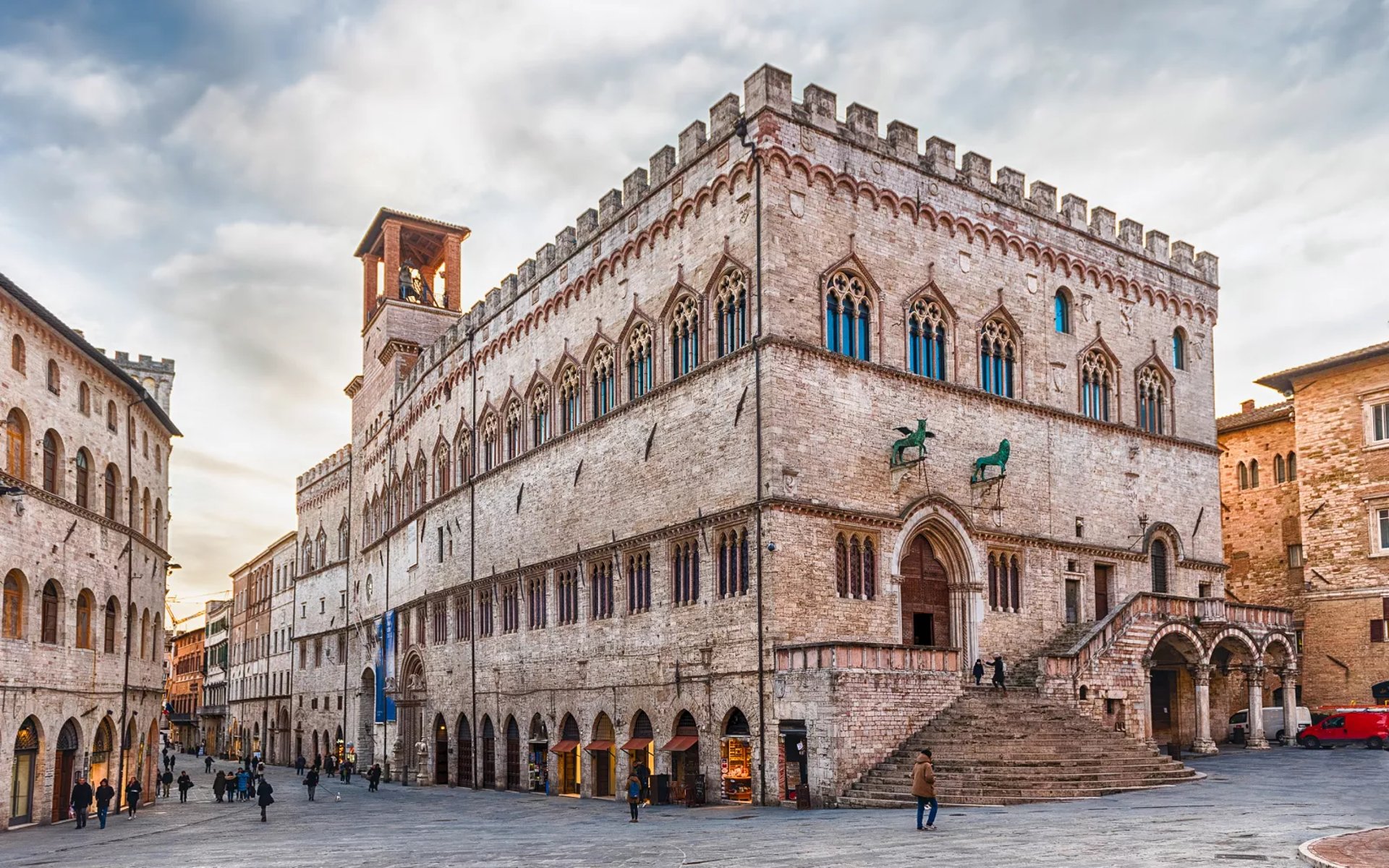
Perugia is the closest city to Podere, yet it hides secrets even Rome doesn't have. The Virgin Mary's ring guarded with 14 keys scattered throughout the city (visible only 2 days a year). An underground fortress you traverse with escalators. Templar paths where no one goes. And one of the world's most beautiful frescoed ceilings in a room that feels like someone's living room.
Oh, and it's also Italy's chocolate and jazz capital. Details...
The city is all uphill, but they invented an escalator system that climbs through medieval entrails. You arrive in the center literally passing inside history. Not a bad entrance, right?
MORNING: IN THE MEDIEVAL HEART
The most spectacular way to reach the center
Park at Piazza Partigiani and take the escalators. But these aren't normal escalators: they pass through a real underground city. The Rocca Paolina was a papal fortress built by razing the houses of a rebel family (the Baglioni, who had the bad idea of challenging the Pope).
Today you walk among the ruins of their neighborhood: streets, arches, walled windows. It's like a movie, but it's all real. When Perugia freed itself from the Pope in 1860, they demolished almost all the fortress as a sign of freedom. What remains is enough to make you feel in a medieval video game.

📍 Podere's tip
Don't take the normal surface route. Enter from the Piazza Partigiani escalators, cross through the ENTIRE Rocca until you exit at Piazza Italia. It's a 5-minute journey through time. Free. And if there are temporary exhibitions, even better.
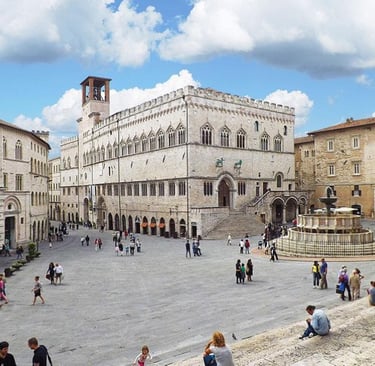
Where everything has converged for 2000 years
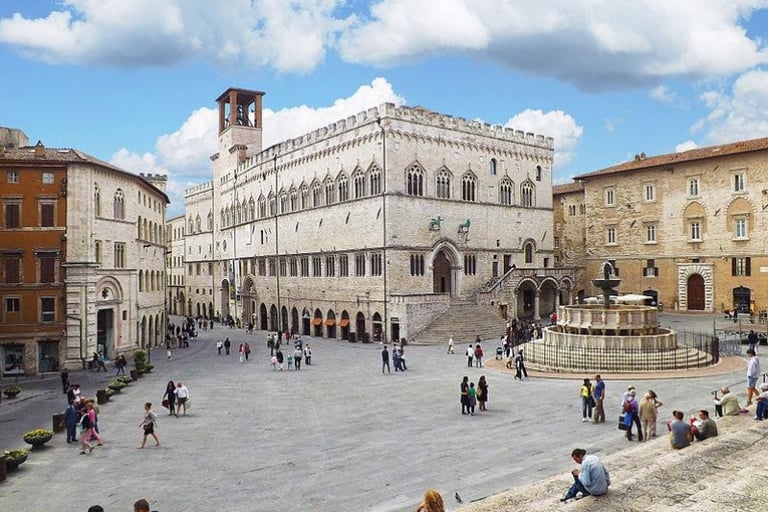
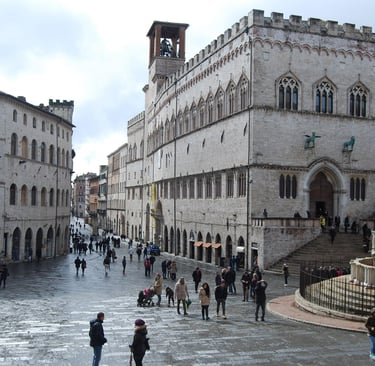
This square is Perugia's heart since Roman times. At the center is the Fontana Maggiore, carved by the Pisanos (father and son, same as Siena Cathedral). It's not just beautiful: it's a 3D history book. There are months of the year, zodiac signs, biblical scenes, saints, and even Aesop's fables. Like a medieval Instagram, but in marble.
The fountain celebrated water's arrival in the city via a new aqueduct (which you can walk on later, if you choose the secret option).
The square overlooks the Palazzo dei Priori (civic power) and the Cathedral (religious power). The Palace hosts the National Gallery with Perugino's works, but if you're short on time skip it and go to Collegio del Cambio which is 100 times better.
📍 Podere's tip
Sit for 5 minutes on the benches. Watch the university students meeting here as always, tourists photographing, Perugians chatting. This square has worked like this for centuries. Zero things have changed.
A secret guarded with 14 keys scattered throughout the city
The Cathedral has an unfinished façade (they admit it themselves), but the interior is a gem. Extraordinary stained glass windows and solemn atmosphere.
But let's get to the point: the Ring mystery. In the Chapel of the Ring, to the left of the entrance, there's a reliquary that (they say) holds the wedding ring Saint Joseph gave to the Virgin Mary on their wedding day. A green stone in gold.
The reliquary is genius: two safes 8 meters high, openable only with 14 different keys. The keys are scattered in historic buildings throughout the city to keep it safe (a medieval form of multi-factor authentication). Only two days a year (July 29-30) they open it and you can see the ring.
True or not? Who knows. But the idea that it takes 14 keys to open it is objectively cool.
In the Cathedral there's also the tomb of a Pope who died in suspicious circumstances (probable poisoning), but we'll see that later if you choose the "dark mysteries" option.
📍 Podere's tip
Even if you can't see the ring (unless you happen to be there July 29-30, and in that case YOU'RE SUPER LUCKY), the story of the 14 keys is worth the visit. And if you love Dan Brown-type mysteries, note: later we'll take you on the Templars' trail.
One of the three perfect ceilings in the world
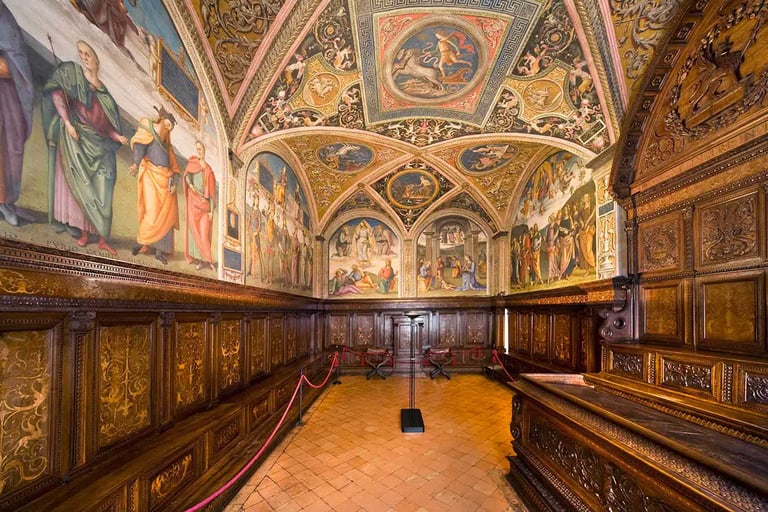
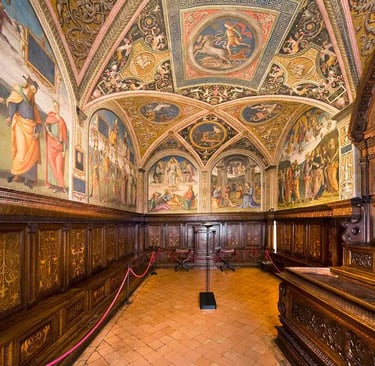
This is the real reason you're in Perugia. From outside it looks like any building. You enter, and you're facing one of Italy's most beautiful places.
The Collegio del Cambio was the medieval bankers' headquarters. In 1496 they called Perugino (a painting rockstar at the time) to fresco the Audience Hall. The result is a fresco cycle that an American writer defined as "one of the three perfect ceilings in the world."
On the walls: Virtues embodied by historical figures like Socrates, Trajan, Pericles. On the vault: planets and allegories. The program is complex, but you don't need to understand it all: you sit, look up, and understand why they defined it "perfect."
The detail everyone seeks: Perugino's self-portrait painted in a fake frame hanging on the wall, with below written (translated) "If the art of painting was lost, I recovered it. If it had never been invented, I created it." Modest, no?
📍 Podere's tip
This is THE must. If you have to pay for one thing in Perugia, it's this. The room is small (max 25 people), so there's a bit of queue on weekends, but it's worth every second. Dedicate 20-30 minutes, sit, look. It's not "tourism," it's experience.
LUNCH BREAK
Time to stop and eat. Perugia offers endless possibilities, from gourmet restaurants to traditional trattorias to street food. Umbrian cuisine is simple but extremely flavorful: porcini mushrooms, black truffle, local cured meats and cheeses, game.
Where to eat:
- Osteria a Priori (Via dei Priori 39): Historic, authentic, traditional Umbrian dishes with a modern touch. Excellent local cured meat and cheese platter. 14th-century setting.
- Trattoria Oberdan (near center): Young, modern, seasonal cuisine. Excellent first courses and great meat selection. Informal atmosphere. Among the highest-rated on TripAdvisor.
- Il Cantinone (Via Maestà delle Volte): In ancient 14th-century cellars, two steps from Fontana Maggiore. Traditional Umbrian dishes with local ingredients. In summer you eat outdoors surrounded by medieval wonders.
- Ristorante del Sole (Via della Rupe 1): Magnificent view of the Umbrian valley. Meat and game specialties, especially wild boar and pigeon. Over 200 wine labels.
Dishes to try:
- Torta al testo: Umbrian "flatbread" cooked on stone, filled with prosciutto, cheeses, vegetables. Real Perugian street food.
- Strangozzi or pici with truffle: Fresh handmade pasta with Umbria's prince ingredient.
- Palombacci: Wild pigeons cooked in terracotta, stuffed with eggs and sausage.
- Gobbi alla perugina: Cardoons au gratin with meat sauce and parmesan (Christmas dish).
🌲 Podere's tip
If you want quick and cheap, look for one of the many "torterie" in the center where they serve freshly made torta al testo. Or go to the Covered Market for a snack with local products.
AFTERNOON: AMONG ETRUSCANS AND PANORAMAS
The lovers' and students' promenade
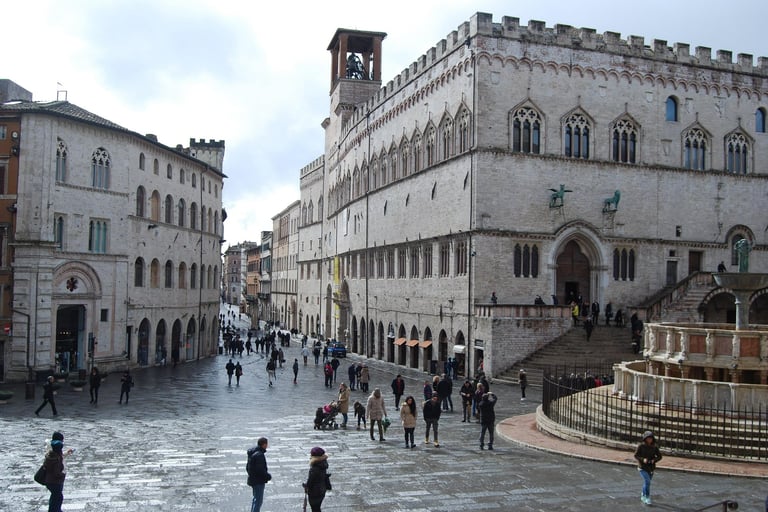
Corso Vannucci is where Perugians "stroll": you walk, see people, stop for coffee. It's flanked by elegant palaces, historic cafés, bookstores, street artists. The atmosphere is young and international (Perugia has a super famous university for foreigners).
Superstition legend: University students NEVER step on the Corso's water drainage channels. If they do, they won't graduate. False? Probably. But no student puts their foot there. Ever.
📍 Podere's tip
Stop at Sandri (historic pastry shop from 1860 with original Art Nouveau furnishings) or Caffè Morlacchi (frequented by generations of students). If you love chocolate, go to Turan Cafè: coffee with extra dark chocolate with view of Piazza IV Novembre. Devastating.
37 meters deep dug 2300 years ago
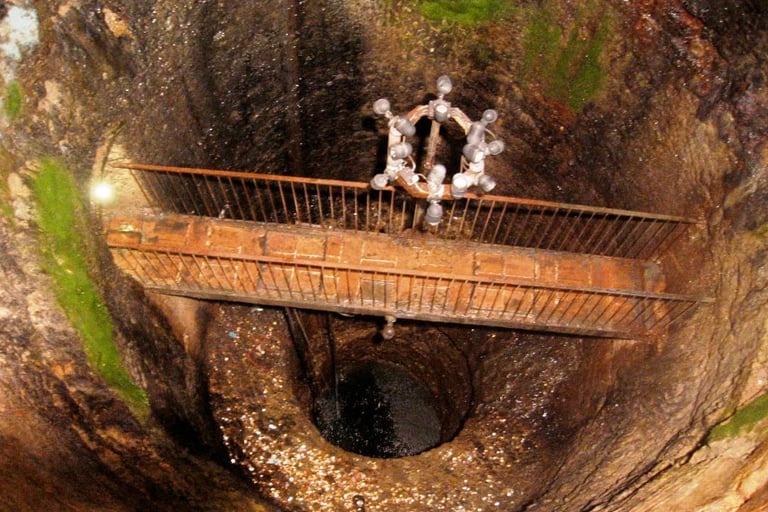
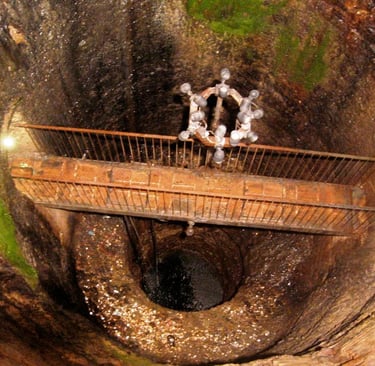
Under Palazzo Sorbello (17th-century house-museum) there's an Etruscan well 37 meters deep carved in the 3rd century BC to have water in case of siege. The Etruscans were so advanced that this thing still works today.
You can descend to the bottom with a staircase and bridge crossing the cavity. The atmosphere is movie-like: flowing water, damp walls, echoes. It's evocative.
📍Podere's tip
Combined ticket with Palazzo Sorbello (€6) is worth it if you have time. If not, skip and go straight to the Etruscan Arch which is free.
2300 years of history superimposed on one gate
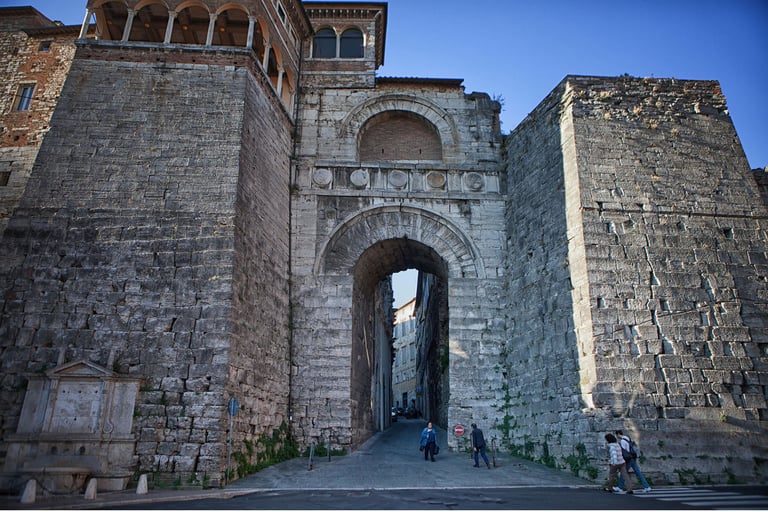
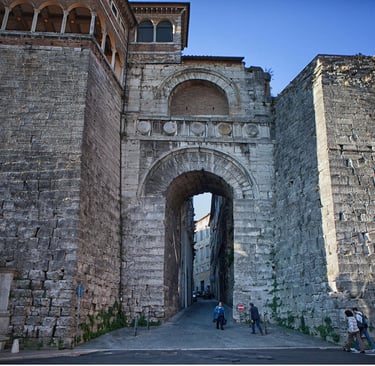
The Etruscan Arch is one of the seven gates of the Etruscan city walls. The base is Etruscan (3rd century BC), above is a Roman addition, on top a Renaissance loggia. It's like a vertical history book.
Curiosity: here too there's the legend of the blinded architect to prevent him from replicating such a beautiful work elsewhere (same legend as Arezzo's clock). Obviously false, but nice.
📍 Podere's tip
Beautiful even in the evening, lit up. If you want to continue toward the Medieval Aqueduct (option A evening), it's close from here.
✨ LATE AFTERNOON / EVENING: PERUGIA'S SECRETS
Now you have three options to end the day, depending on your interests. You can choose a panoramic walk off the tourist circuits, a Templar path full of mystery, or explore the city's darkest places linked to suspicious deaths and legends.
OPTION A: The Medieval Aqueduct – Perugians' Secret Walk
From Fontana Maggiore begins a path almost no tourist knows, but Perugians love: the walk on the Medieval Aqueduct. It was the conduit bringing water from Mount Pacciano to the fountain. When it stopped functioning in the 1800s, they transformed it into an elevated pedestrian street.
The result? You literally walk between houses, halfway between street and roofs. They built buildings on both banks, creating an absurd perspective. The best section is in the Porta Conca area (near University for Foreigners).
OPTION B: The Templar Path – On the Knights' Trail
Path for those who love Dan Brown and medieval mysteries. Start: Corso Garibaldi, a medieval street full of Templar esoteric symbols.
First stop: Church of San Cristoforo (deconsecrated)
Mysterious church closed to worship, Templar symbols everywhere. Abandoned location atmosphere.
Second stop: Temple of San Michele Arcangelo
Paleochristian temple (5th-6th century) built on an even older sacred site: Etruscans and Romans already venerated it. Circular plan, ancient columns, almost magical atmosphere. Christianity just took the place of millennia-old cults.
Third stop: Templar Church of San Bevignate ⭐
The most important Templar testimony in Perugia. Extraordinary frescoes depicting battles, knights' life, Order symbols. It's a very rare historical document. After the Templar Order's suppression (1312), it passed to the Knights of Malta.
OPTION C: Perugia's Dark Mysteries – The Devil's Eye and the Poisoned Pope
Percorso per chi ama il lato oscuro della storia.
First stop: San Pietro Complex and the Devil's Eye
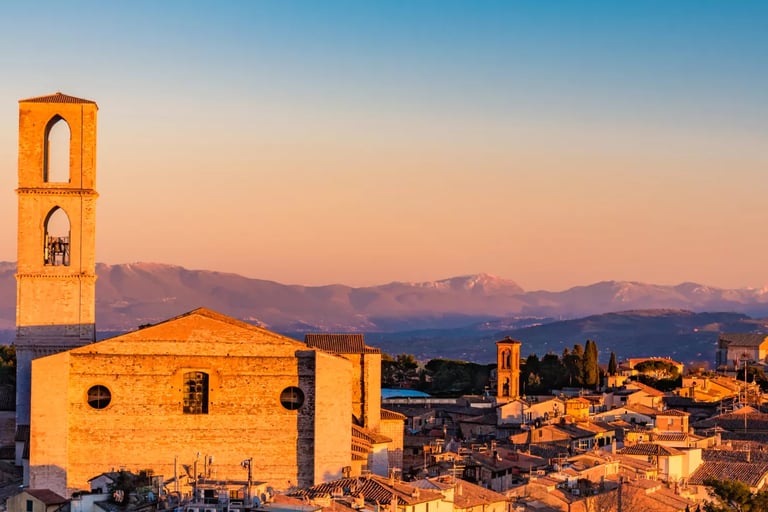
Benedictine complex from the 10th century with beautiful church and magnificent wooden choir. But the real legend concerns the mysterious "Devil's Eye": according to tradition, there's a point in the complex (no one knows exactly where) that brings bad luck or evil to whoever looks at it. No one knows what it is. And this feeds the mystery.
Visiting it at sunset has particular charm. It's in a quiet area, immersed in greenery.
Second stop: Basilica of San Domenico and the Pope Who Died in Suspicious Circumstances
The Basilica of San Domenico is Umbria's largest Gothic church. But the real mystery is in Cappella Guinigi: sepulcher of Pope Benedict XI, who died in Perugia in 1304 after only 8 months of papacy.
The circumstances were never clarified: some historians hypothesize poisoning ordered by France's king (the Pope was in conflict with him). Others speak of poisoned figs. The tomb is a Gothic masterpiece, but is surrounded by a mystery never dissipated.
BONUS: Perugina Chocolate House
The Bacio Museum – Only if You Love Chocolate (or Have Children)
Perugina's company museum in San Sisto (15 min from center). Guided tour 1h30 with:
- Historical museum (invention of Bacio by Luisa Spagnoli in 1922, who called it "Cazzotto" - "Punch" - for its shape!)
- Tasting (Baci from production line)
- Factory view (when operational)
- Chocolate School (courses by reservation)
Sweet experience for children. If you prefer the historic center, skip it: Perugina chocolate is in all center shops anyway.
PRACTICAL INFO
📍 Distance from Podere
How to Get There from Chiusi
- Car: 45 km, about 35 minutes via SS146 and Perugia bypass
- Train: Chiusi-Terontola-Perugia (with change), about 1h15
Perugia is the closest city to Podere Grotta Antica: perfect for a day trip even last-minute!
⏱️ How Much Time Needed
- Half day (4-5 hours): Essential historic center (Piazza IV Novembre, Cathedral, Collegio del Cambio, Corso Vannucci)
- Full day (7-8 hours): Complete itinerary with one evening path (Aqueduct, Templars or Mysteries)
- Two days: Everything at leisure + Chocolate House or Lake Trasimeno excursion
🌅 Event not to miss
Umbria Jazz (July 11-20)
One of the world's most important jazz festivals. Since 1973, every July Perugia becomes the world jazz capital for 10 days. Crazy lineup (Miles Davis, B.B. King, Eric Clapton, Sting, Santana have played here), but the real magic is that more than half of ~250 events are FREE. Marching bands through the streets, nighttime jam sessions, concerts in squares. Unique atmosphere.
Eurochocolate (November 14-23)
10 days of sweet madness. One of Europe's largest chocolate festivals, nearly a million visitors. The center fills with stands, chocolate sculptures, tastings, workshops. Chocolate in every possible form. Free event (you only pay for what you buy).
Curiosity: It was in October, but from 2024 they moved it to November because October became too hot for chocolate (climate change).
Perugia awaits you just 35 minutes from Podere.
The closest city, with the deepest secrets.