The Tufa Villages: Pitigliano, Sovana and Sorano
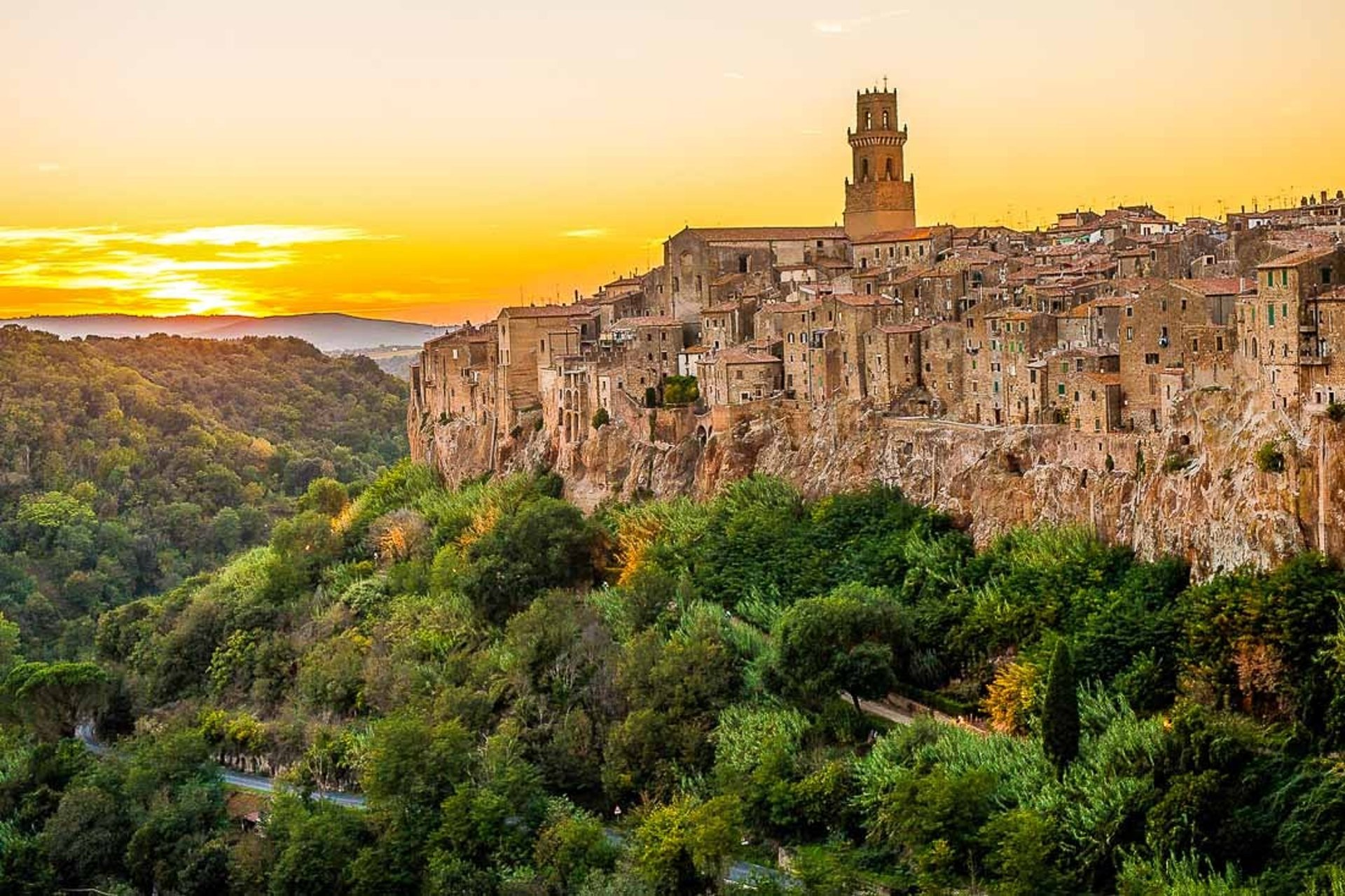
Imagine driving through honey-colored hills, crossing landscapes that look like they're from a movie, and finding yourself in front of impossible villages suspended in the void. Pitigliano with the Jewish ghetto carved in rock, Sovana with Etruscan tombs hidden in the woods, Sorano with silent alleys and the sunset setting the tufa on fire. It's a journey that changes you: every village tells three thousand years of history, every stone has a voice, every via cava is a mystery to explore.
There are places where time stands still, carved into honey-colored volcanic rock. The Tufa Villages are three jewels suspended between sky and earth: Pitigliano with its Jewish ghetto and houses hanging over the void, Sovana a perfect medieval village with monumental Etruscan tombs, Sorano called "the Matera of Tuscany" for its alleys carved in stone. A dramatic and intense journey into the heart of authentic Maremma, where every corner tells three thousand years of history.
From Chiusi to the Tufa Villages: A Day Among History, Stone and Wonder
Three villages that seem to have grown from the rock itself, connected by scenic roads crossing the tufaceous countryside.** Pitigliano welcomes you with the impossible profile of houses that continue the vertical tufa wall. Sovana conquers you with the silence and intact beauty of the Middle Ages. Sorano surprises you with deserted alleys and caves inhabited until a few centuries ago. In between, Etruscan necropolises hidden in the woods and vie cave (sunken roads) carved by hand in the rock two thousand years ago.
🌅 MORNING: Pitigliano, the Little Jerusalem (09:00-12:30)
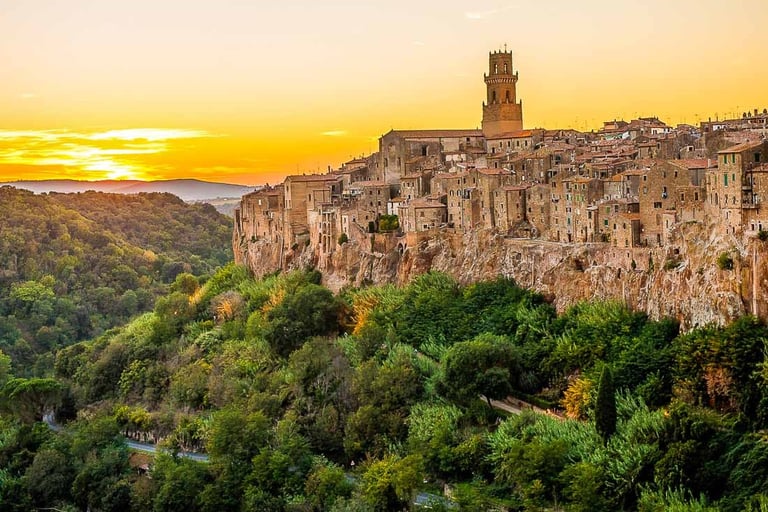
When you arrive in Pitigliano, you stop. In front of you there's an impossible sight: the village rises on a tufa spur overhanging the valley, and the houses seem to continue the vertical rock. You can't tell where the tufa ends and where the buildings begin. It's a single honey-colored sculpture suspended in the void.
You start from the Medici Aqueduct, the arched structure that dominates the entrance and took over 100 years to build. From Piazza della Repubblica you take the best photos: the panorama is breathtaking. Then you dive into the old town's alleys, narrow, uphill, with century-old trees sprouting from the tufa walls.
But the heart of Pitigliano is the Jewish Ghetto, reason why it's called "The Little Jerusalem". In the 16th century, hundreds of Jews fleeing persecution found refuge here. The community grew to 600 people and left an indelible mark. The ghetto path is a moving journey: the Synagogue still active, the matzah oven where bread was baked for Jewish Passover, the kosher butcher, the cellar where they still produce kosher wine today, the ritual bath for purification. Everything carved in tufa, everything preserved, everything visitable. During World War II the local population hid and protected the Jews, earning the title of "Righteous Among the Nations" from Jerusalem.
Don't miss Palazzo Orsini with the Etruscan Archaeological Museum and frescoed rooms, and the Cathedral of Saints Peter and Paul with its imposing baroque façade.
Before leaving, taste the Sfratto dei Goym: an elongated biscuit filled with honey and walnuts from Jewish tradition. The stick shape bitterly recalls how Medici messengers knocked on doors to evict Jews and confine them in the ghetto. A piece of history you can eat.
📍 Podere's tip
Arrive early, around 9 am. The ghetto deserves an hour and a half of quiet visit: don't limit yourself to the Synagogue, go down into the underground rooms carved in tufa. The cellar, the oven, the ritual bath tell the daily life of a community that lived here for centuries. And buy the Sfratto: it costs little but it's a memory worth keeping.
🍽️ LUNCH: Sovana, the village suspended in time (12:30-15:00)
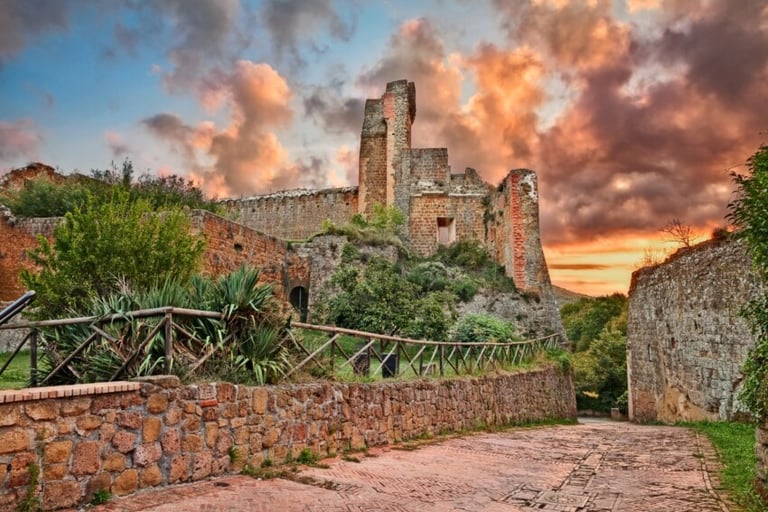
Seven kilometers and you're already in Sovana, one of Italy's most beautiful villages. Here time really stopped: less than 500 inhabitants, a single main street crossing the center, almost absolute silence. Sovana is like a perfectly preserved medieval film set, but real, alive, authentic.
The village develops on an axis: on one side the Rocca Aldobrandesca reduced to ruins but still imposing; on the other the Cathedral of Saints Peter and Paul, a Romanesque-Gothic Tuscan masterpiece. In the middle, Piazza del Pretorio with its still-original herringbone floor: the Archive Palace with the clock and bell tower, the Captain's Loggia with the Medici coat of arms, the Pretorio Palace hosting the Archaeological Museum.
A tidbit few people know: the Cathedral has a perfect astronomical orientation. On June 21, at summer solstice, the first morning sunray enters from the eastern window and crosses the entire nave illuminating the sacred elements in sequence. Pure magic.
And then there's the Treasure of Sovana: in 2004, during restoration work, they found a vase with 498 gold coins from the 5th century. The treasure that according to legend inspired Dumas's "The Count of Monte Cristo". Today it's visible in the dedicated museum.
Sovana gave birth to Pope Gregory VII, the one who humiliated the emperor by forcing him to three days of penance in the snow at Canossa. His birthplace is along Via del Duomo.
For lunch, Taverna Etrusca (Via del Pretorio) welcomes you with exposed beams and summer terrace: here you taste acquacotta sovanese with poached egg (the poor soup of Maremma tradition) and beef tagliata with artichokes. Or Vino al Vino Enoteca, more informal but with excellent platters.
📍 Podere's tip
Don't rush. Sit in Piazza del Pretorio, observe the silence, breathe the atmosphere. Sovana is small but dense: every stone tells a story. And for lunch, acquacotta is a dish you won't find elsewhere: simple, poor, but with a flavor that tells centuries of peasant life.
☀️ AFTERNOON: Etruscan Necropolis + Sorano "the Tuscan Matera" (15:00-18:30)
A few kilometers from the village, immersed in the woods, there's the Etruscan Necropolis: monumental tombs sculpted directly in the tufaceous rock, with highest-level decorations. A unique heritage in the world.
The protagonist is the Tomba Ildebranda, the most monumental: built like an Etruscan temple with 12 columns, two side stairs, a frieze with griffins and rosettes. Even though deteriorated, it makes you understand how sophisticated the Etruscan civilization was. It takes its name from Ildebrando of Sovana, the future Pope Gregory VII.
Also spectacular the Tomb of the Winged Demons (discovered in 2004): on the pediment stands an imposing winged marine demon with fish tails, identifiable with Scylla. A statue depicts Vanth, the Etruscan female demon. The Tomb of Typhon and the Pola Tomb complete the quartet.
The necropolis is crossed by the Cavone, the main via cava: a corridor carved in tufa by the Etruscans with very high walls. Along the path you find an Etruscan inscription and an ancient swastika (sun symbol).
The woods are lush, the silence total, the atmosphere magical. It takes 45 minutes to visit the main tombs, but every single step is worth it.
📍 Podere's tip
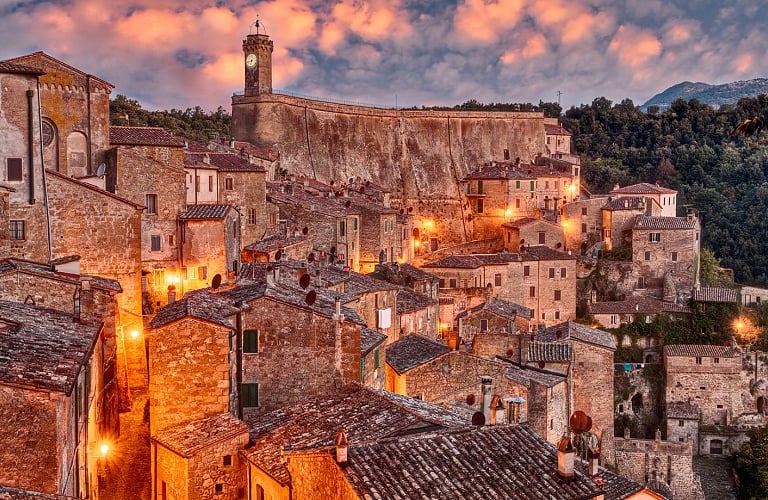
Sorano should be experienced at sunset. The light hitting the tufa creates incredible orange and pink shades. Go up to Masso Leopoldino around 6 pm and stay there until sunset. And if you have time, do Via Cava di San Rocco: 20 minutes walk and you find yourself in another world.
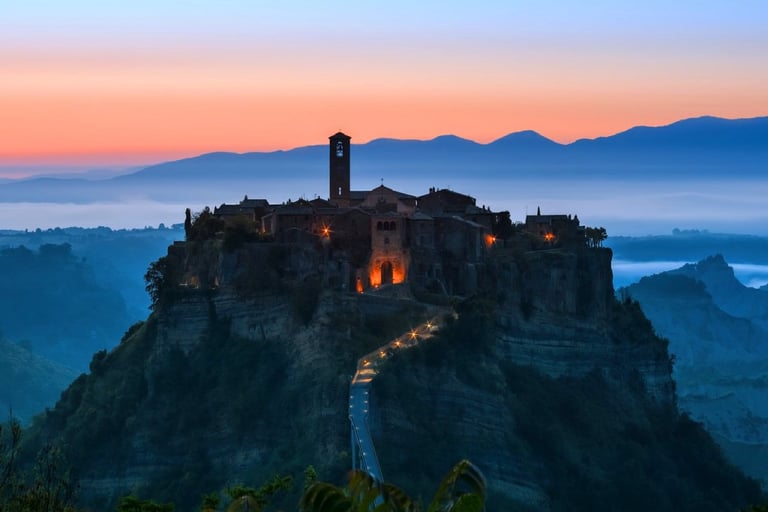
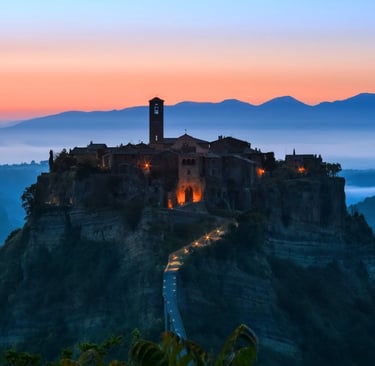
Last stop: Sorano, the "Matera of Tuscany". If Pitigliano surprises with its dramatic position, Sorano fascinates with its suspended atmosphere. The alleys are deserted, silent, the houses fit into each other like a stone puzzle, arches appear suddenly. It's a village you experience by walking slowly, getting lost.
You enter from Porta di Sopra (at the foot of the Fortress) or Porta dei Merli and find yourself in a perfectly preserved medieval labyrinth. The Orsini Fortress dominates the village: built by the Aldobrandeschi and then expanded by the Orsini, it's one of Maremma's most imposing defensive systems. Today it hosts the Museum of the Middle Ages and Renaissance. From the fortress the panorama is spectacular.
The Masso Leopoldino is a fortified structure built in the 18th century to consolidate the cliff after a devastating landslide. Today it's a breathtaking viewpoint: from here you see all of Sorano, the Lente river valley, the tufa changing color with the sunset light.
But Sorano's magic is walking in the old town alleys: narrow alleys, stairs carved in rock, dwellings that look like caves, travertine portals, heraldic crests. The Church of the Collegiate of San Nicola preserves a 16th-century baptismal font. The Jewish Ghetto (established in 1619) is less known than Pitigliano's but equally interesting.
If you still have energy, the Via Cava di San Rocco starts from the village and takes you to the rupestrian settlement of San Rocco: caves carved in tufa, remains of fortifications, a small church. The viewpoint offers a magnificent view of Sorano. But you can also simply sit in one of the panoramic loggias and watch the sunset turn the tufa red.
For dinner (if you stay), Cantina L'Ottava Rima (Via del Borgo, 25) is a small tavern inside a tufa cave: few tables, homely atmosphere, traditional dishes and excellent fish menu. Or Hosteria del Borgo, with panoramic terrace and authentic Maremma cuisine.
📍 Podere's tip
Tomba Ildebranda is imposing, but don't neglect the Tomb of the Winged Demons: the pediment with Scylla is extraordinary and the discovery is recent, so less known. Bring water: the path is in the woods but in summer it's hot. And walk in silence: the atmosphere here is powerful.
🌟 IF YOU HAVE TIME: Vitozza, the lost city (BONUS)
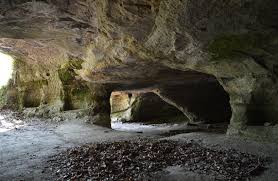
If you have a full day or want to return, Vitozza is an extraordinary experience. Located 2 km from San Quirico (Sorano hamlet), it's the largest rupestrian settlement in central Italy: over 200 caves inhabited until the 18th century, two ruined medieval castles, a dilapidated church called "Chiesaccia", and colombari (caves for raising pigeons) from Roman times.
The route is a loop, about 4 hours on foot, always in the shade of the woods. Along the path you see caves on multiple levels, with stairs and passages carved in tufa, water cisterns, holes for beds, chimneys. Some still preserve the names of families who lived there in 1783, when the Lorena made the census. It's like walking in a ghost town where nature has reclaimed everything.
The colombari are the most suggestive part: rooms with dozens of small niches in the walls, used to raise doves and pigeons to sell at the market. For centuries they were fundamental for the community's sustenance.
Free entry, parking at San Quirico sports field, well-marked route. Bring comfortable shoes and water. It's a magical, almost mystical place, completely off the tourist circuits.
📍 Podere's tip
Vitozza is for those seeking adventure. The route is easy but long: 4-hour loop, always in the woods. Leave early in the morning, bring a picnic, and enjoy the silence. The most beautiful caves are in the second half of the route. And the colombari, at the end, are worth the entire walk alone.
PRACTICAL INFO
📍 Distance from Podere
Chiusi → Pitigliano: 67 km (1h 15min)
- Complete itinerary: ~150 km
⏱️ Things to know
- Necropolis cumulative ticket: (Sovana Necropolis + Orsini Fortress + San Gregorio VII Museum). Worth it.
- Pitigliano Jewish Ghetto: visit duration: 1h-1h30. Open every day except Jewish holidays.
- Parking: All villages have free or paid parking (€1-2/hour) outside the walls. Pedestrian old towns.
- Restaurants: Book for lunch on weekends, especially in Sovana (small village, few restaurants).
- Vie Cave: If you want to walk in the vie cave (San Rocco, Cavone), bring comfortable shoes. They can be slippery.
- Vitozza: Free entry, 4 hours on foot. Leave in the morning if you want to include it.
- Perfect combo: Tufa Villages + Saturnia Hot Springs (25 km from Pitigliano). Free waterfalls always accessible.
🌅 Seasonality
- Spring (March-May): Ideal. Mild temperature, green countryside, few tourists, necropolis in lush woods.
- Summer (June-August): Hot but beautiful. Bring water for the necropolis. Tufa villages are cooler thanks to the stone.
- Autumn (September-November): Perfect. Autumn colors of Maremma, harvest, golden sunset light. October is the best month.
- Winter (December-February): Cold but evocative. Deserted villages, authentic atmosphere, low prices. Bring heavy jacket.
Ready to get lost in the Tufa Villages, where time has stopped in stone?
Podere Grotta Antica is your perfect base: just over an hour from Pitigliano, you wake up in the Tuscan countryside and in one day explore one of Maremma's most authentic and dramatic places. After an intense day among ghettos, necropolises and tufa villages, you return home for a quiet dinner and a night in a 17th-century farmhouse. The real Tuscany, the one you don't forget.