
Villages and natural thermas in Val d'Orcia
The itinerary where Val d'Orcia offers you panoramic views from above and relaxation in warm waters
Imagine climbing up to a fortress at 896 meters, with Val d'Orcia spread beneath you like a living painting. Then walking through medieval villages where time has stopped, with stone alleys and squares that look like movie sets. And finally immersing yourself in steaming thermal waters at 48°C, inside natural pools carved by time in the white rock of an enchanted forest.
This itinerary combines the best of Val d'Orcia: panoramic fortresses dominating the valley, authentic villages off the tourist routes, and free hot springs where warm water flows from the earth. From Radicofani with its imposing tower visible from kilometers away, passing through Castiglione d'Orcia and the impregnable Rocca di Tentennano, to the thermal waters of Bagno Vignoni and Bagni San Filippo with the famous White Whale.
The route follows a precise logic: it starts from above, with fortresses and panoramas, and gradually descends toward the hot springs. Bagni San Filippo is the last stop — because once you immerse yourself in the warm water and enjoy the relaxation, you won't want to get back in the car covered in thermal mud to visit other villages. Better to enjoy the bath as the grand finale and then return to the Podere clean and relaxed.
A day between history, breathtaking views, and waters flowing from the heart of the earth. The Val d'Orcia you didn't expect.
Val D'Orcia: panormic villages and natural hot springs
The route draws an arc in southern Val d'Orcia, starting from Podere Grotta Antica heading south. First, you climb to Radicofani, the highest village in the valley with its medieval fortress dominating the landscape. Then you descend toward Castiglione d'Orcia, with a detour to Rocca di Tentennano and the hidden village of Vignoni Alto. Continue to Bagno Vignoni with its iconic water square and the Mills Park. Finally, conclude at Bagni San Filippo's free hot springs, perfect as the last stop for a regenerating bath before returning.
STOP 1: RADICOFANI
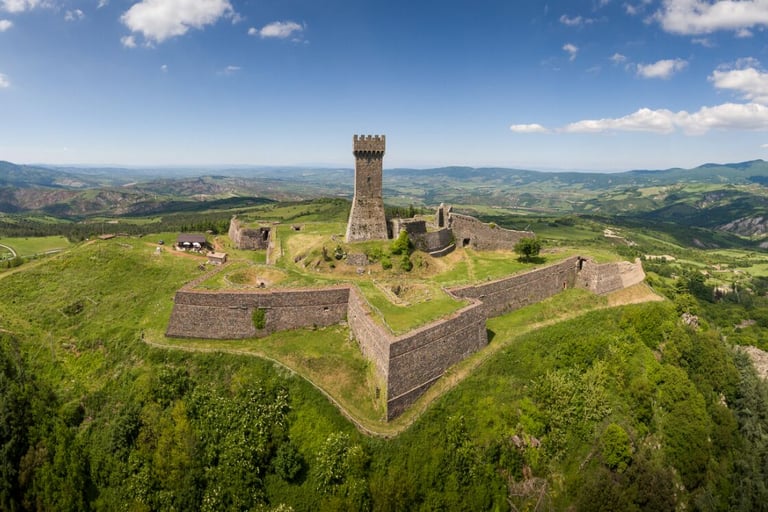
You see it from afar, the Fortress of Radicofani. It's impossible not to notice: a powerful tower standing at 896 meters, the highest point in the entire Val d'Orcia. When you arrive, you understand why for centuries it was contested between the papacy, Siena, and Florence — from up here you control everything.
The village climbs around the fortress, a tangle of stone alleys rising toward the main square. At the center, the Church of San Pietro from the 13th century preserves splendid Della Robbia terracottas and wooden statues, including a Madonna with Child by Francesco di Valdambrino worth the visit. In the Maccione Gardens you'll find the statue of Ghino di Tacco, the "Robin Hood of Val d'Orcia" who in 1297 seized the fortress and used it as a hideout for his acts of brigandage. Dante mentions him in the Divine Comedy, Boccaccio in the Decameron — he was famous for not completely robbing his victims and even sparing the poorest.
But climbing up to the Fortress makes the experience unforgettable. The ticket costs just a few euros and lets you walk among towers, bastions, and restored walkways. Inside there's the Cassero Museum with archaeological finds from the Bronze Age to Etruscan times. But the real spectacle is climbing the tower: from up there the view spans all of Val d'Orcia, from Monte Amiata to the Crete Senesi, to Lake Bolsena and Trasimeno. The gaze reaches so far it almost seems to sense the planet's roundness.
📍 Podere's tip
If you have time, take a walk in Bosco Isabella, a romantic and esoteric garden created by the Luchini family between the late 1800s and World War II. It extends for 2.5 hectares along the southern walls of the village and is a corner of tranquility away from mass tourism. And if it's lunchtime, stop at Trattoria La Grotta in Piazza Sant'Agata — the place is literally carved inside a natural stone cave. Tuscan specialties like ribollita and rabbit alla francescana, convivial atmosphere and honest prices (20-35€). A place where time has stopped and tradition is still alive.
STOP 2: CASTIGLIONE D'ORCIA
Descending from Radicofani, the landscape changes. The hills soften, the clay badlands give way to vineyards and olive groves. Castiglione d'Orcia appears perched on a slope of Monte Amiata, with its stone and brick houses seeming to grow from the rock itself.
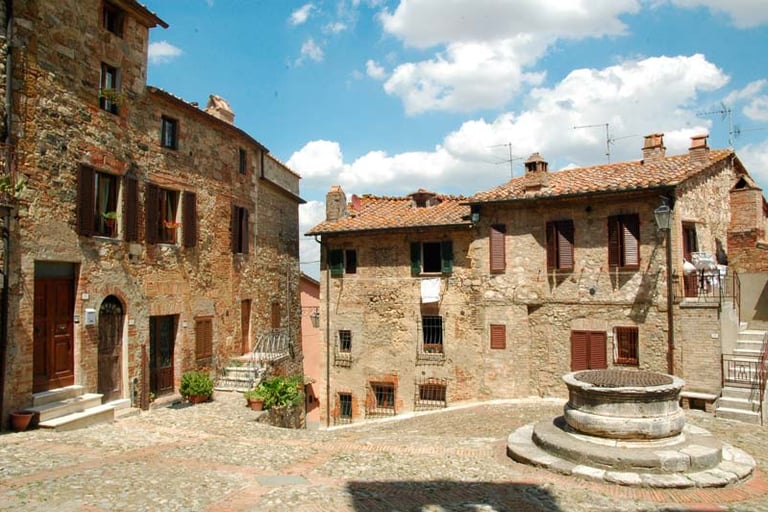
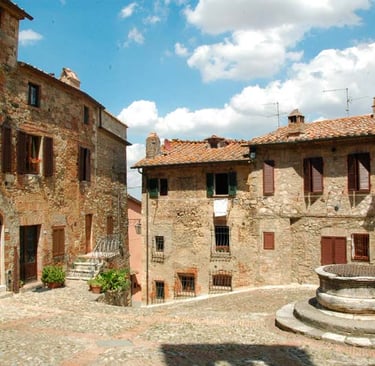
The heart of the village is Piazza Il Vecchietta, dedicated to painter and sculptor Lorenzo di Pietro called "il Vecchietta," born here in 1412. The square has an irregular triangular shape, paved with cobblestones of rough stones and cut by red brick strips. At the center, a 16th-century travertine well. All around, ancient palaces with their warm colors offer suggestive views. Looking up, you see the Rocca Aldobrandesca dominating from above — today it's in ruins and closed for restoration, but even just walking around it you admire the remains of medieval walls that for centuries defended this strategic place.
Don't miss the Sala d'Arte San Giovanni, a small museum housing works by Simone Martini and il Vecchietta — three splendid Madonnas with Child that alone are worth the visit. And the Church of Santa Maria Maddalena, a 12th-century Romanesque building with a 13th-century façade and semicircular apse.
📍 Podere's tip
Don't stop here. Less than a kilometer away, on a rocky spur seemingly emerging from the earth, stands the Rocca di Tentennano. It's one of Val d'Orcia's most fascinating fortresses: built in the 12th century, it's the only one in the valley never to have been conquered. Today it hosts permanent and temporary exhibitions, and from its terrace the panorama embraces all of Val d'Orcia and Monte Amiata. It's said that Santa Caterina da Siena stayed here, learning to read and write in this very place thanks to a miracle.
At the foot of the fortress, on the opposite side from Castiglione, lies the tiny village of Rocca d'Orcia — just 34 inhabitants. Its jewel is the Piazza della Cisterna, with an enormous medieval octagonal cistern defined in the 17th century as "the most beautiful vase in the State of Siena" for its water's quality. Houses climb along the uphill alleys, creating a timeless atmosphere.
And if you really want to escape mass tourism, climb to Vignoni Alto — a medieval fortified village reachable only on foot (2.5 km from Bagno Vignoni), perched on a hill right above the hot springs. Narrow streets, stone houses, Romanesque church of San Biagio, and a panoramic view of Val d'Orcia that takes your breath away. Few know it, and that's precisely why it's worth the detour.
STOP 3: BAGNO VIGNONI
Bagno Vignoni is unique in the world. It doesn't have a normal square: it has a pool. A 16th-century rectangular pool (49x24 meters) occupying the entire center of the village, with steaming thermal water at 52°C gushing from 1000 meters deep. All around, the houses, the church of San Giovanni Battista, the Loggiato di Santa Caterina — because Santa Caterina da Siena came here to immerse herself in boiling water to "mortify the flesh" (though to us it seems more like pleasure than penance).
Lorenzo de' Medici loved to retreat here to study and heal. Pope Pius II Piccolomini was a regular visitor. The water, rich in minerals, is beneficial for bones, skin, and mucous membranes. But today, for public decency reasons, bathing is forbidden in the central pool. You can look at it, photograph it, admire the steam rising at dawn or sunset creating magical atmospheres, but you cannot immerse yourself.
The water flows from the square toward a steep escarpment, where the Mills Park lies — a place of rare suggestion. Here, in the Middle Ages, four underground mills were carved into the rock, exploiting the thermal water's energy. Thanks to the constant flow of the source, they functioned even in summer when other mills in the area stopped. Today you can visit them, walking along the path that follows the gorelli (small channels) and accumulation pools, admiring the white limestone concretions created by mineral deposits from the water.
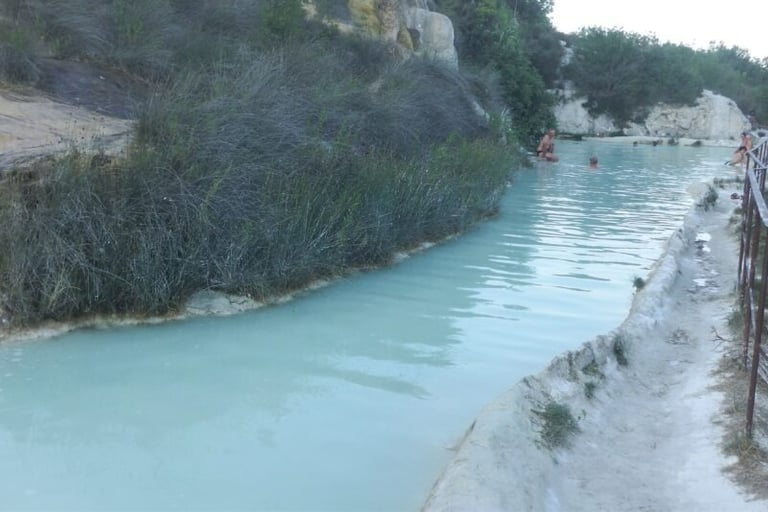
Along the escarpment there are natural and artificial pools where water collects. They look inviting, but beware: since 2010 bathing has been prohibited with fines from 25 to 500 euros. Signage is almost absent and many continue bathing there ignoring the ban, but the risk exists.
🌲 Podere's tip
If you really want to take a thermal bath in Bagno Vignoni in complete legality, continue toward the natural pool a bit lower down, where no prohibitions exist. Aquatic plants keep the water clear and steps help you descend. Oops... but I must warn you: here the water is cold! It's not thermal like the pools above, so if you're looking for warmth you should head directly to the last stop. Alternatively, Bagno Vignoni has three paid thermal establishments (Terme Spa & Resort, Terme Hotel La Posta, Terme Hotel Adler) where you can enjoy warm waters in complete safety and comfort.
STOP 4: BAGNI DI SAN FILIPPO
This is the final stop. The grand finale. And there's a precise reason: here you can really bathe in the free hot springs, without prohibitions and without fines. But above all, once you immerse yourself in the warm water and enjoy the relaxation, you won't want to get back in the car covered in thermal mud to visit other places. Better to conclude here, let yourself be pampered by 48°C water, and then return to the Podere clean and relaxed.
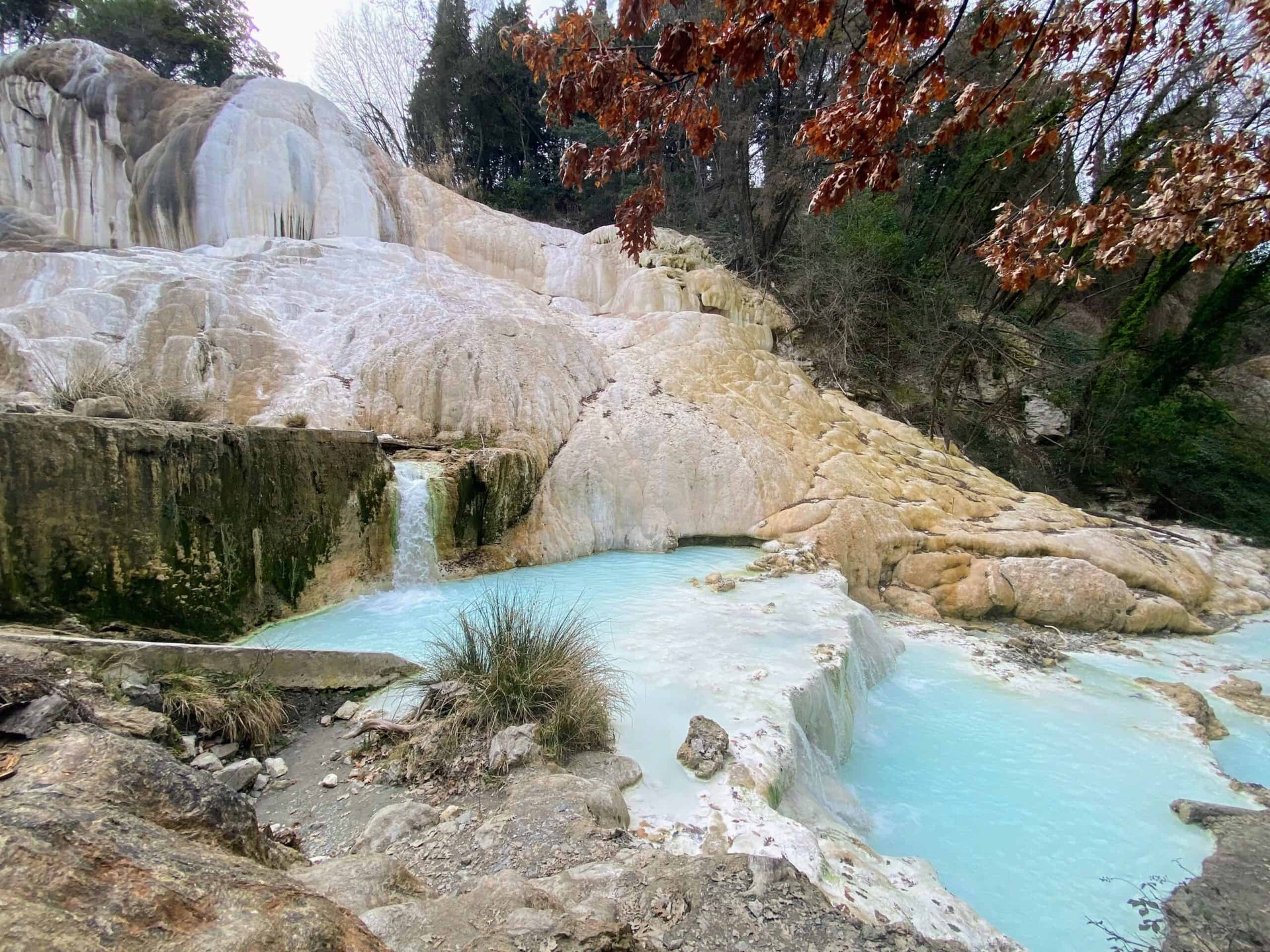
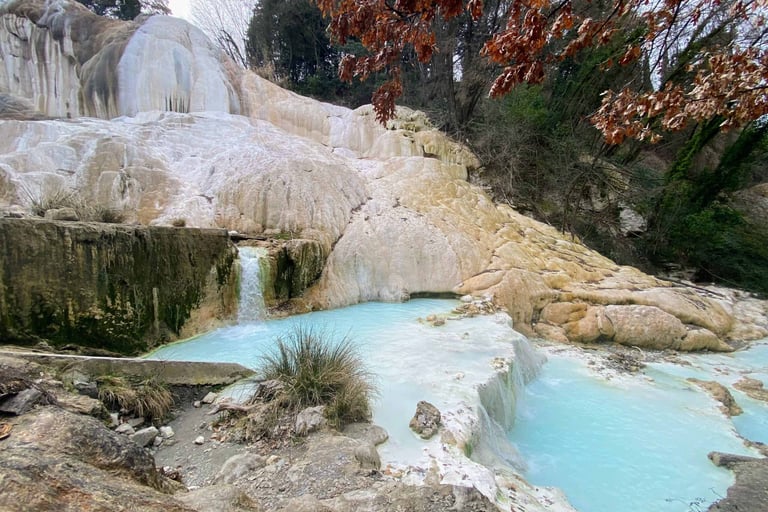
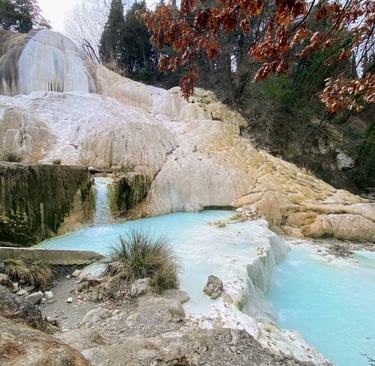
Bagni San Filippo is a tiny village at the foot of Monte Amiata. Few inhabitants, a bar, a church. And a magical forest where a warm river flows. Thermal waters gush from the mountain and flow into the Fosso Bianco, creating a fairytale landscape of white limestone formations, waterfalls, and natural pools.
Park along the main road (paid parking, about 10€ for the day — there are also some free parking spots but they're few and fill up quickly). From there, just a few minutes on foot along a forest path to reach the first pools. The sulfur smell guides you — impossible to get lost.
The first pools you encounter have transparent and warm waters, but in small quantities — enough to keep them lukewarm, but not for a truly relaxing bath. Continue along the path following the stream, and after a few minutes you find yourself facing a breathtaking spectacle: the White Whale.
It's an enormous white limestone block — about 30 meters long — formed by sediments deposited by thermal waters over centuries. The shape really resembles a whale's mouth, hence the name. Here flow the warmest waters (48°C at the source, cooling slightly descending but remaining very pleasant even in winter). Under the waterfall, you'll find natural little pools carved in the rock where you can fully immerse yourself. Often visitors create improvised small pools with stones, branches, and leaves — limestone deposits quickly cement them making them waterproof. On the bottom, precious thermal muds deposit for skin and body treatments.
The quantity and path of water changes frequently, transforming the scenery with new shapes and colors. In winter, thermal waters mix with rainwater rich in organic or mineral material, creating green or reddish-brown shades. When the sun is high, its rays illuminate the White Whale making the limestone crystals shine almost blindingly — a spectacle not to be missed.
📍 Podere's tip
Arrive early morning or toward sunset. In summer Bagni San Filippo can be very crowded, especially on weekends. At dawn or sunset you'll find fewer people and an even more magical atmosphere. Bring swimsuit, towel, drinking water, and comfortable shoes — the path can be muddy, especially after rain. And remember: here the water is really warm even in mid-winter, so this experience is perfect in any season. Don't forget your camera: the White Whale under the right light is one of Tuscany's most photogenic places.
🗺️ How to Organize Your Day
From Podere Grotta Antica head south toward Radicofani (30 minutes). Dedicate the morning to the fortress and village, then descend to Castiglione d'Orcia (10-15 minutes). Visit the village, Rocca di Tentennano, and if you have time, make the detour to Vignoni Alto. From Castiglione continue to Bagno Vignoni (10 minutes) — stop here to admire the water square and take a walk in the Mills Park. Finally, conclude the day at Bagni San Filippo (18 km, 20 minutes from Bagno Vignoni) where you can relax in the free hot springs. The return to Podere takes about 35-40 minutes. The entire route can be comfortably managed in one day, with time to enjoy each stop unhurried. The important thing is to leave Bagni San Filippo as the last stop — once immersed in warm water, you won't want to visit other places.
PRACTICAL INFO
📍 Distanza dal Podere
Chiusi → Radicofani: 30 minuti (28 km)
Radicofani → Castiglione d'Orcia: 10-15 minuti
Castiglione d'Orcia → Bagno Vignoni: 10 minuti
Bagno Vignoni → Bagni San Filippo: 20 minuti (18 km)
Bagni San Filippo → Podere Grotta Antica: 35-40 minuti
⏱️ Good to know
- Swimsuit and towel mandatory for Bagni San Filippo
- Comfortable shoes (paths can be muddy)
- Bring drinking water
- Bagno Vignoni: free hot springs PROHIBITED (fines 25-500€), natural pool below legal but cold
- Bagni San Filippo: free hot springs LEGAL and very warm
- Radicofani: castle closed some days (check hours)
🌅 When to Go
Spring (April-May): Val d'Orcia explodes in bright green and flowers. Temperatures are perfect for walking and hot springs are delightful. Fewer tourists than summer.
Summer (June-August): It can be hot during the day, but hot springs are perfect for cooling off. Bagni San Filippo is more crowded on weekends — better go early morning or evening. Villages are lively with events and festivals.
Autumn (September-October): The warm colors of harvest make the landscape even more evocative. Ideal temperatures, fewer crowds, peaceful atmosphere. One of the best periods.
Winter (November-March): Steaming hot springs in the cold create an almost mystical atmosphere. Villages are deserted, more authentic. Fog wraps Val d'Orcia offering painterly scenes. Bring heavy clothes for villages, but in 48°C water you'll be fine even with snow.