The Perfect Villages of Val di Chiana
The Perfect Loop for Those Seeking Authentic Tuscany
There's a Tuscany that doesn't shout, doesn't sell itself, simply exists. It's the one of medieval villages in Val di Chiana, where every stone tells two thousand years of history and every square hides a treasure that no guidebook will ever completely reveal. This itinerary is for those who want to get lost in the Etruscan alleyways of Cortona, taste the most famous porchetta in Tuscany in Monte San Savino, and be amazed by a gold reliquary that took 121 years to complete in Lucignano.
Three villages, three different souls, one common thread: authenticity. Here you won't find mass tourism or artificial scenery. You'll find craftsmen working ceramics with the same medieval techniques, innkeepers cooking recipes passed down through five generations, and views over Val di Chiana that will make you forget why you were in such a hurry.
The Perfect Villages of Val di Chiana: Cortona, Monte San Savino, and Lucignano
Together, these three villages give you a day you won't forget. It's not the kind of experience you solve in three Instagram photos: it's the kind you carry inside, that sends you home with your head full of images, your heart full of emotions, and probably some leftover porchetta in the trunk.
MORNING: Cortona - The Etruscan Pearl of Valdichiana
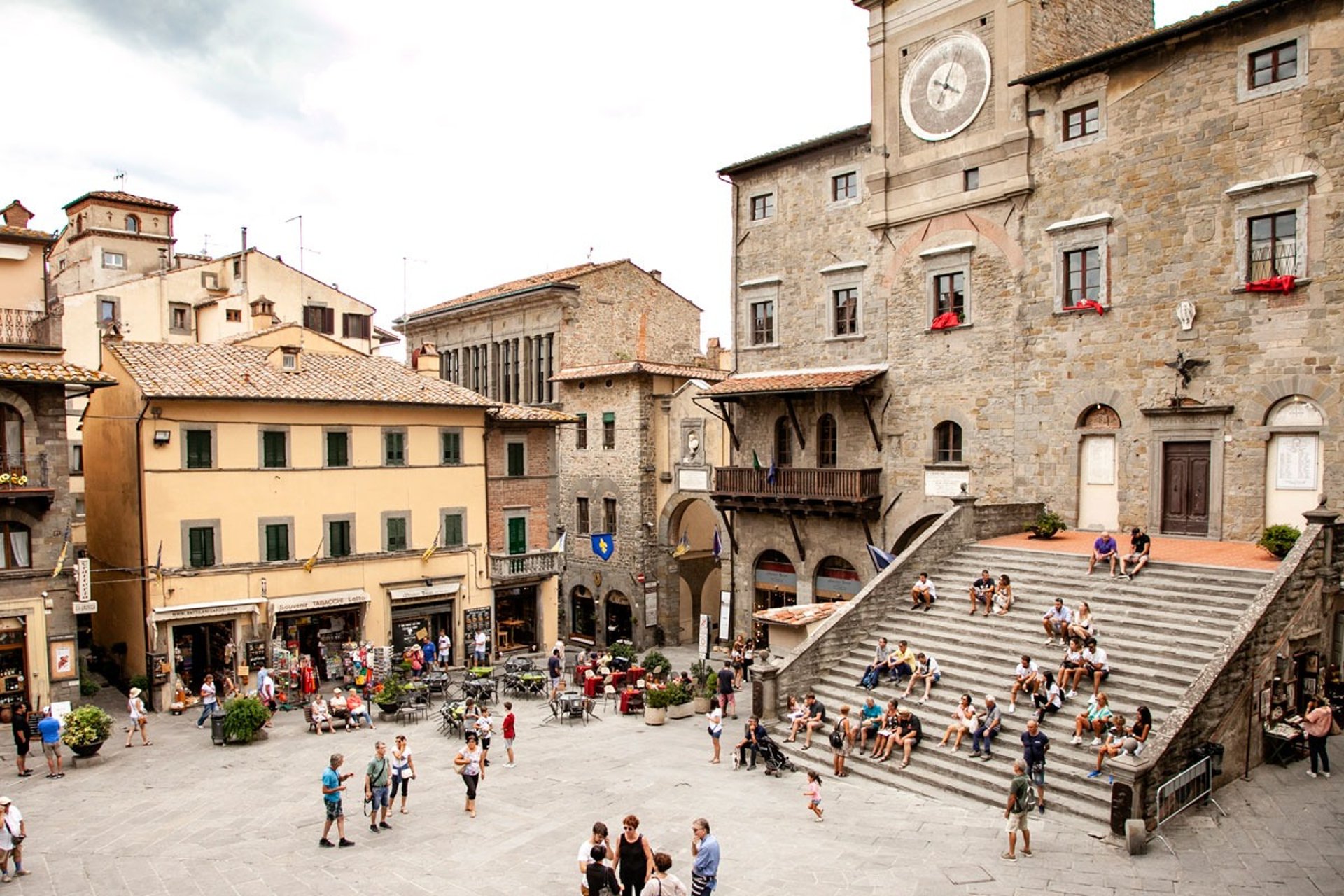
Cortona isn't just any village: it's one of the twelve cities of the Etruscan Dodecapolis, with 2,500 years of history imprinted in its cyclopean walls. But its real magic lies in the perfect mix of historical grandeur and village intimacy: here you can admire masterpieces by Fra Angelico and Luca Signorelli, then stop at a wine bar where the owner calls you by name by your second visit.
What to See
MAEC - Museum of the Etruscan Academy
The museum that made Cortona the "Etruscan capital" of Tuscany. The absolute star is the Etruscan Chandelier (4th century BC), a bronze masterpiece made with the lost-wax technique that defies the laws of physics. Then there's the Tabula Cortonensis, the third longest Etruscan text ever found: a contract for the sale of a vineyard proving how seriously the Etruscans took their wine (some things never change in Tuscany).
Don't miss:
- The gold panther-shaped fibula (Etruscan jewelry that would make Cartier pale)
Fortezza del Girifalco (Girifalco Fortress)
Built in 1556 by Cosimo I de' Medici, this fortress has a curious particularity: it was never used in a war. Created to defend Cortona, it ended up becoming a prison and then a refuge during World War II. Today it hosts exhibitions and events, but the real show is the view from the Bastion of Santa Margherita: Val di Chiana, Lake Trasimeno, and on clear days even Monte Amiata.
Via Jannelli - The Most Medieval Street in Cortona
If you're looking for the authentic soul of Cortona, escape the main streets and slip into Via Jannelli. It's a time tunnel: 14th-century stone houses with the upper floor jutting out over the street, supported by wooden beams and brackets. You almost expect a medieval merchant to emerge from a doorway.
Curiosities You (Probably) Didn't Know:
- Cortona has the only completely flat street in the entire village: Via Nazionale, also called "Rugapiana" (ruga = ancient Tuscan street, piana = flat). Everything else is a continuous up and down.
- The obelisk in Piazza Garibaldi is dedicated to the "hero of two worlds" who... never set foot in Cortona. And the cannons decorating the monument? They were used in a completely different battle, in Castelfiorentino. But it looks good.
- In the Sanctuary of Santa Maria delle Grazie al Calcinaio (Renaissance masterpiece just outside the walls), they venerate an image of the Madonna that performed miracles in the 15th century. The church was built specifically to house it.
🍽️ LUNCH: Monte San Savino and the Perfect Porchetta
Monte San Savino is the village where Renaissance culture meets the most authentic gastronomic tradition of Tuscany. Here was born Andrea Contucci called "il Sansovino" (sculptor who left his mark on the Italian Renaissance), but here they mainly celebrate porchetta – Monte San Savino even holds the record for the world's longest porchetta. If you don't taste porchetta here, you've missed the opportunity of a lifetime.
What to See
Il Cisternone - The Underground Water Cathedral
This is the hidden gem of Monte San Savino. The Cisternone is a 16th-century underground cistern, second largest in Tuscany (after Livorno): 400 square meters, 2 meters deep, hypnotic architecture with brick vaults and columns emerging from emerald green water.
The effect is astonishing: you walk on a metal walkway suspended above the water, with light effects illuminating the red bricks and crystalline water. It's like entering an underwater cathedral. It's located under Palazzo di Monte (town hall) with hanging gardens above.
Logge dei Mercanti (Merchants' Loggias)
Elegant Renaissance loggia attributed to Sansovino, on Corso Sangallo. Perfect for a stroll between architecture and shops.
Cassero
The ancient 14th-century fortress, robust three-story building with four turrets and a keep. Today it houses the Ceramics Museum. You can climb the tower for the view.
Church of Sant'Agostino
Contains a beautiful Assumption by Giorgio Vasari (yes, that Vasari). The interior is a jewel of Tuscan art.
Curiosities You (Probably) Didn't Know:
- Monte San Savino is the birthplace of Pope Julius III (Giovanni Maria Ciocchi del Monte), who reigned from 1550 to 1555. Not bad for such a small village.
- The Cisternone was connected to a rainwater collection system from the roofs throughout the town. Renaissance engineering that still works today.
- Every year, in late August/early September, there's the Porchetta Festival with tastings, competitions, and the legendary giant porchetta.
Where to Eat (and Taste the Porchetta)
Taverna del Sansovino (Historic center)
The temple of Savinese porchetta. Rustic atmosphere, home cooking, sublime porchetta. Here they make porchetta the right way: crispy outside, soft inside, fragrant with herbs. Pair it with a good local red and you're in gastronomic paradise.
Ristorante Roggi dal 1950 (Via della Tinaia, 9)
Historic: in 1950 the Roggi family took over an ancient trattoria and wine tavern. Today it's a restaurant and pizzeria. Welcoming atmosphere, Tuscan cuisine, excellent pizza. Outdoor tables.
La Piana (if you prefer more refined cuisine, just outside Monte San Savino)
Typical Tuscan cuisine revisited in a modern key, rustic but refined environment. Excellent quality-price ratio for a more sophisticated experience.
AFTERNOON: Lucignano and the Golden Tree
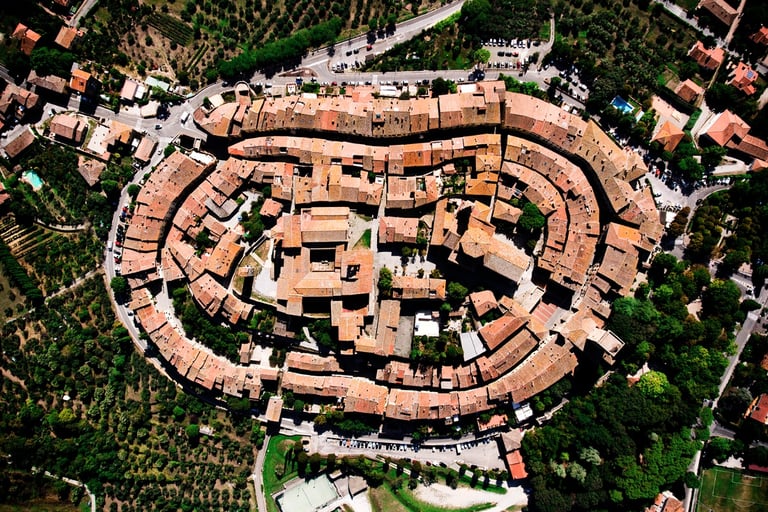
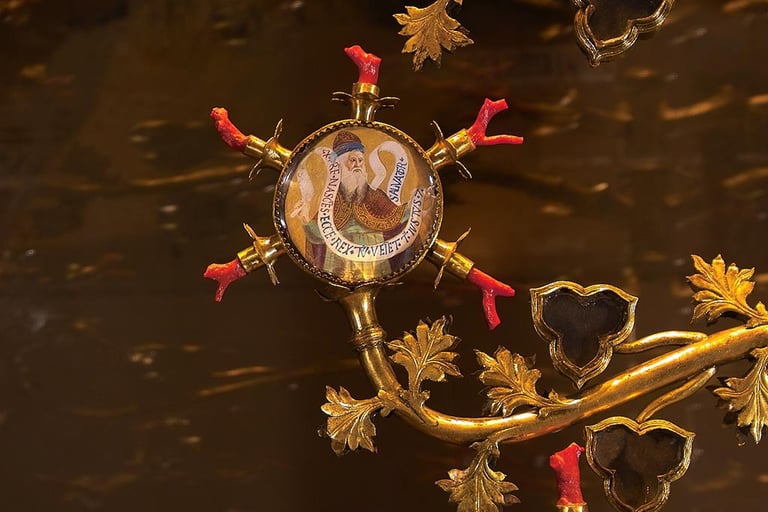
Lucignano has an elliptical concentric layout – the only one in Tuscany. This means the village is structured in concentric rings converging toward the center, like a perfectly geometric medieval labyrinth. But the real wonder is inside the Municipal Museum: the Golden Tree (or Tree of Life), a 2.5-meter-high reliquary all in gold, silver, coral and crystals that took 121 years to complete (1350-1471). A unique goldsmith masterpiece in the world.
What to See
The Elliptical Village - Historic Center
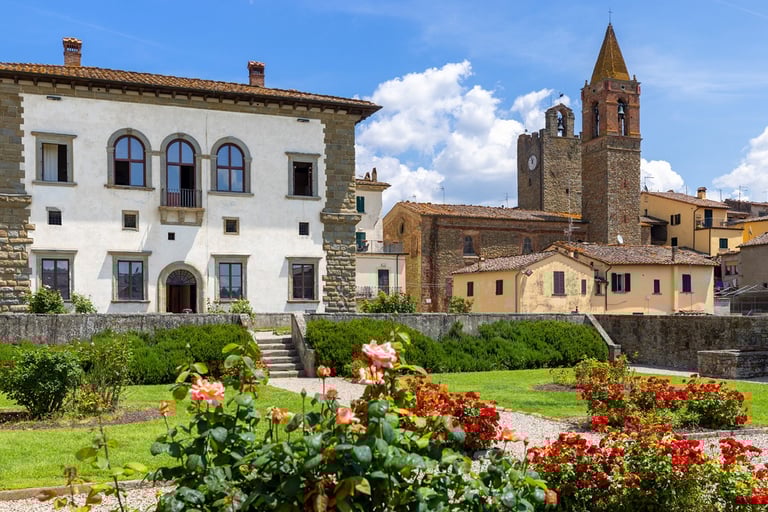
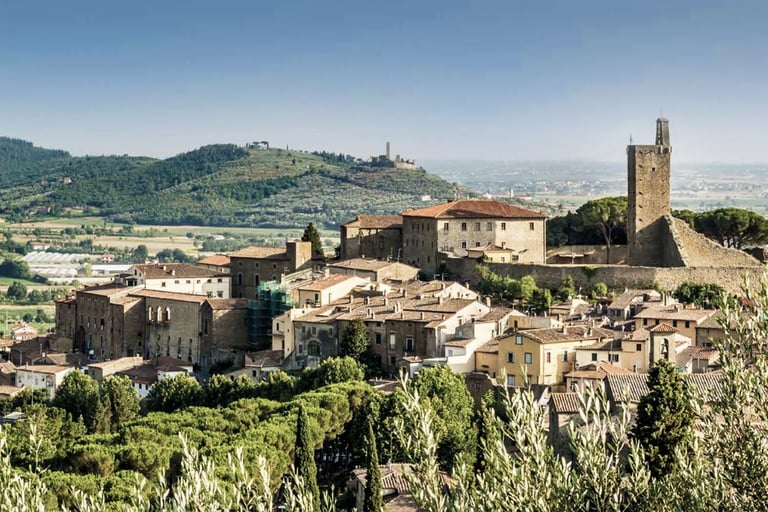
Getting lost in Lucignano is a pleasure: follow the concentric rings leading to the center, cross narrow streets, arches, medieval doorways. Every corner is a photo opportunity. The village has the Orange Flag from the Italian Touring Club and is part of The Most Beautiful Villages in Italy.
Maggiolata Lucignanese (Late May)
If you happen to be in Lucignano the last two weekends of May, you'll experience a unique spectacle: the Maggiolata Lucignanese, a folkloric festival where the four districts of the village compete by creating allegorical floats decorated with over 100,000 fresh flowers. The final Sunday ends with a "flower battle" in front of 7,000+ spectators. It's one of Italy's most beautiful flower festivals.
The Golden Tree (Tree of Life) - Municipal Museum
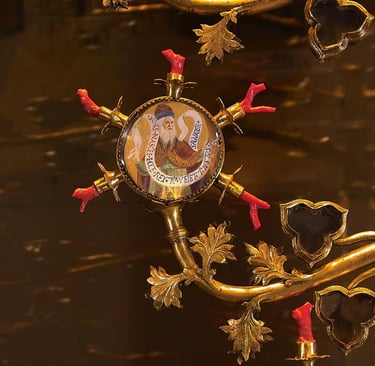
It's impossible to describe in words the beauty of this reliquary. It's a gilded copper tree, two and a half meters high, with 12 branches from which hang small trilobed cases that contained Franciscan relics and fragments of Christ's Cross. On top, a crucifix and a pelican (symbol of Christ sacrificing himself for humanity). Below, threads of red coral, rock crystals, enamels, precious stones.
Created by different generations of Sienese goldsmiths between 1350 and 1471, it was a collective work spanning over a century of history. In 1914 it was stolen and dismembered, found by chance in 1917 in a cave in Sarteano (not far!). Restored, it has now returned to its splendor.
Curiosity: On February 14th (Valentine's Day) the Tree is displayed during the "Segni d'Amore" (Signs of Love) event – Lucignano is also known as the "City of Love".
Curiosities You (Probably) Didn't Know:
- Lucignano was the set of the film "Certified Copy" (2010) by Iranian director Abbas Kiarostami, with Juliette Binoche.
- The elliptical structure of the village is extremely rare: in all of Italy there are very few examples of medieval urban planning with such perfect concentric ring layout.
- The village is nicknamed "Pearl of Valdichiana" for its harmonious shape and the care with which it has been maintained.
🌆 IF YOU HAVE TIME: Castiglion Fiorentino at Sunset
Castiglion Fiorentino is Cortona's "neighbor village" (only 10 km away), with a winning card: the Logge del Vasari (Vasari's Loggias) in Piazza del Municipio, a panoramic terrace overlooking Val di Chio and Val di Chiana. Quiet, authentic village with Orange Flag, without the tourist siege of Cortona.
What to See
Logge del Vasari (Vasari's Loggias)
Elegant Renaissance loggia designed by Giorgio Vasari (the architect/painter/writer who told the life stories of all the great Renaissance artists). From here, spectacular view over the valleys.
Cassero + Tower
Ancient fortress, now home to the Archaeological Civic Museum and the Ceramics Museum. You can climb the tower for the panorama.
Curiosity:
- Roberto Benigni was born in a hamlet near Castiglion Fiorentino. Even comic Tuscany has its roots here.
PRACTICAL INFO
📍 Optimal Visit Strategy
- Early morning in Cortona (09:00 AM - 12:00 PM): The village fills with tourists around noon. Arrive early, visit MAEC and Fortress, then get lost in the alleys before the crowds.
- Lunch in Monte San Savino (12:30 PM - 02:00 PM): It's the perfect time for porchetta. Book if you can, especially in high season.
- Afternoon in Lucignano (03:00 PM - 05:00 PM): The afternoon light makes the village even more magical. The Municipal Museum with the Golden Tree closes around 6:00 PM (check seasonal hours).
- Castiglion Fiorentino (optional): If you still have energy, it's a brief stop (1 hour) for sunset from the Vasari Loggias.
If time is short: Focus on Cortona (the largest and richest) + Lucignano (the Golden Tree is unmissable). You can visit Monte San Savino quickly just for the Cisternone and porchetta.
⏱️ Products to Take Home
- Porchetta (whole or sandwich) from Monte San Savino
- Artisan ceramics in Cortona and Lucignano
- Valdichiana extra virgin olive oil – everywhere
- Vino Nobile di Montepulciano – Montepulciano is 20 minutes from here
- Golden Tree miniature (souvenir) from the Lucignano Museum shop
🌅 Seasonality
- Spring: Maggiolata Lucignanese (late May) – unique spectacle
- Summer: All villages very lively, Cortona On The Move (photography festival, July-September)
- Autumn: Val di Chiana turns golden, perfect melancholic atmosphere
- Winter: Silent and authentic villages, ideal for those avoiding mass tourism. Cortona has Christmas markets.
Ready to discover Val di Chiana as a true insider, not as a passing tourist?
Podere Grotta Antica is your perfect base to explore these villages without rushing: leave in the morning at your leisure, return for dinner, and if you feel like repeating the tour the next day (maybe going deeper into just one village, getting lost in its alleys with more time), you have all the freedom to do so. This is the Tuscany we love: the one that isn't exhausted in a photo, but asks to be lived, savored, breathed.